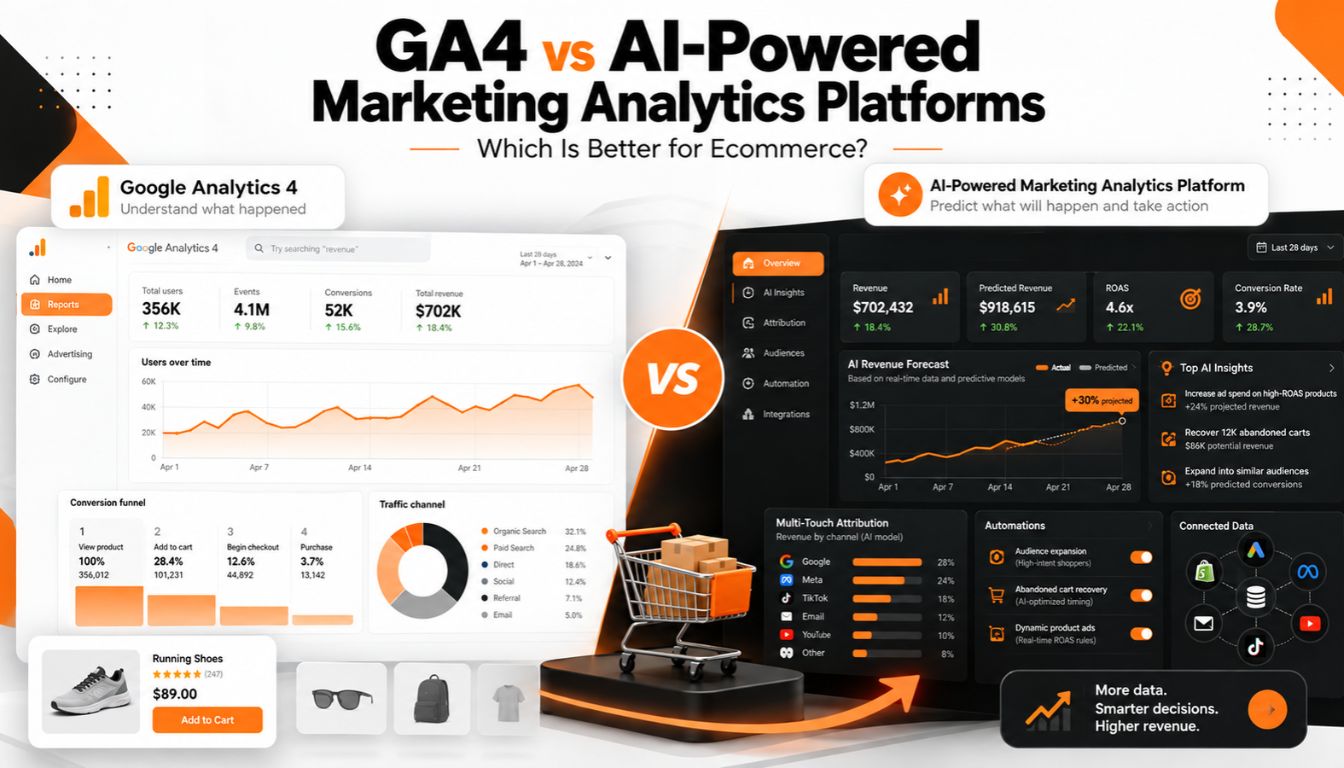
For most ecommerce brands that spend across two or more paid channels, AI-powered marketing analytics beats GA4 on the questions that move budget. GA4 counts sessions and events well, and it costs nothing. AI platforms resolve individual customers, attribute revenue across every channel, and predict who buys next. Keep GA4 as one data input, then add a platform like LayerFive, where Signal handles attribution and identity, Edge builds predictive audiences, and Juno delivers agentic AI insights. Single-channel stores can stay on GA4 longer.
TL;DR
GA4 is a free, capable tool for traffic and event tracking, and it feeds Google Ads bidding. It was not built to run an ecommerce profit and loss. According to a 2026 analysis reported by Webtonic, only 48% of GA4 ecommerce setups track purchase events, and 87% of Shopify Plus stores run with no dedicated attribution platform. Gartner’s 2026 CMO Spend Survey shows CMOs putting 15.3% of marketing budgets into AI while only 30% say their organizations are ready to scale it. Deloitte’s 2026 retail and CPG survey found 75% of executives call AI a top priority and just 16.5% can quantify a return. The pattern is plain: money is moving into AI faster than the data foundation underneath it. AI-powered analytics platforms repair that foundation with identity resolution, cross-channel attribution, and prediction. The practical path for most Shopify brands is to keep GA4, check its purchase count against store orders, and add an AI platform once spend crosses two paid channels. This guide shows how to run that test.
What is the difference between GA4 and AI-powered marketing analytics platforms?
GA4 is Google’s event-based web analytics tool. It records sessions, events and conversions on your site and passes signals to Google Ads. AI-powered marketing analytics platforms start somewhere else. They pull in data from every ad channel, store and email tool, match activity to individual customers across devices, and use machine learning to attribute revenue and predict behavior. GA4 describes traffic. These platforms are built to guide budget decisions.
Both categories get called analytics, which hides how different they are. GA4 is a collection layer. It gives you a record of what happened on your site, assuming the tag fires. An AI-powered platform sits above collection. It joins that record with ad spend, order data, email activity and customer history, then models what drove revenue and what is likely to happen next. LayerFive makes the longer version of this argument in its post on why GA4 ecommerce analytics is not enough.
Google did add a conversion attribution analysis report in early 2026. According to Seresa’s write-up of the launch, it shows assisted conversions and where each touchpoint sits in the journey. That is a real improvement, and it deserves credit. It still analyzes only the events GA4 can see, so it inherits every gap in the underlying data.
Where does GA4 fall short for ecommerce in 2026?
GA4 falls short for ecommerce in three places. Purchase tracking is often incomplete, attribution only covers touchpoints that fire the GA4 tag, and individual customers are not resolved across devices. According to a 2026 analysis reported by Webtonic, only 48% of GA4 ecommerce implementations track purchase events, although 97% track page views. That gap weakens revenue attribution before any model runs.
I want to be fair to GA4 here. It is a competent free tool, and most of these shortfalls come from its design goals. Google built it to work for a hobby blog and a Fortune 500 retailer alike. Ecommerce teams need depth on the customer, and GA4 trades that depth for breadth. Three gaps show up again and again.
Why does GA4 miss ecommerce purchases?
Purchase events decide whether GA4 can connect revenue to a channel. When they are missing or partial, product reports and channel credit drift away from what Shopify recorded. A practical test is to compare GA4 purchases with store orders for the same period. According to Enalitica’s 2026 guidance, a GA4 purchase count more than 15% below store orders is too incomplete to steer budget alone.
Missing events are only part of the story. Ad blockers, declined consent and redirect failures stop tags from firing at all, so the lost purchases never enter the attribution math. Seresa, citing Putler’s 2026 data, reports that GA4 undercounts ecommerce revenue by 10 to 20% against WooCommerce order records. That figure comes from WooCommerce stores, so treat it as directional for Shopify, then run the order comparison on your own store.
Why is GA4 attribution limited to what it can see?
GA4 attribution can only weigh touchpoints it observes. Email clicks, SMS, influencer codes and spend from non-Google channels reach it only if you engineer the connection. Improvado’s 2026 implementation guide makes the same point: GA4 attribution considers sessions tracked by its own tag. LayerFive’s analysis argues this tilts credit toward channels Google can see. That leaves large parts of the journey unscored.
Look at what most brands use instead. According to an Eightx analysis of 74,777 stores, reported by Webtonic in 2026, 87% of Shopify Plus stores run with no dedicated attribution platform and rely on platform-native analytics. Each ad platform then grades its own homework. Meta claims one number, Google claims another, Shopify records a third, and GA4 shows a fourth. Nobody in the room trusts any of them.
Why does GA4 stop at the browser?
GA4 assigns anonymous browser identifiers, so one shopper who browses on mobile, clicks an email and buys on desktop can look like three people. AI-powered platforms resolve those signals to one profile. LayerFive reports that standard tools identify 5-15% of site visitors while LayerFive Signal identifies 2 to 5 times more. That is the difference between measuring sessions and measuring customers.
Treat that number as a vendor claim and test it. Ask any platform what share of your own traffic it will resolve to persistent profiles, and ask to see the figure in a trial. LayerFive’s Identity Resolution for Growth field guide walks through how to judge providers on that question. Without identity, customer journey analytics and reporting stay fragmented, and every downstream model inherits the fragments.
What do AI-powered marketing analytics tools do differently?
They do four things GA4 does not. They unify spend, store and customer data in one place. They resolve identities into persistent profiles. They attribute revenue across every channel using inspectable models. They predict purchase intent and push those audiences back into ad platforms and email. Newer platforms add agentic AI that watches the numbers and flags problems before a weekly review catches them.
Here is how those four pieces translate into daily work for a Shopify team.
Unified data means first-party customer data analytics that does not depend on someone exporting a CSV. Spend from Meta, Google, TikTok and Klaviyo lands beside orders and margin, so one screen answers which channel earned what.
Identity resolution turns anonymous sessions into customer profiles. That is the base for AI-driven marketing attribution, because a model can only credit a journey it can see end to end. It also gives you suppression lists, so you stop retargeting people who already bought.
Cross-channel marketing performance tracking then becomes possible. Instead of trusting each platform’s self-reported return, you compare channels on the same revenue number. Attribution models stay open to inspection, which matters when finance asks why you moved 20% of budget.
Predictive ecommerce analytics scores visitors for purchase propensity and product affinity, then sends those audiences to Meta, Google and Klaviyo. For a deeper look at the category, see LayerFive’s guide to AI analytics platforms for ecommerce.
GA4 vs AI marketing analytics: how do they compare side by side?
GA4 wins on price and on site behavior reporting. AI-powered platforms win on identity, cross-channel attribution, prediction and activation. The table below compares the two across the capabilities ecommerce teams use to allocate budget. Read it as a category comparison. Individual tools vary, so verify any claim in a trial against your own store orders before you commit. Each row maps to a decision budget owners make weekly.
Capability GA4 AI-powered marketing analytics platform Primary job Site and app event measurement Revenue attribution, prediction and activation Data scope Events tracked by the GA4 tag, plus Google Ads Ad platforms, store, email, SMS and CRM data unified Customer identity Anonymous browser and device identifiers Persistent first-party profiles across devices Attribution Data-driven model trained inside Google’s data Multi-touch, cross-channel, inspectable models Prediction Purchase and churn probability for users Google can match Scoring for every identified visitor on your own data Activation Audiences sync mainly to Google products Audiences pushed to Meta, Google, Klaviyo and more Cost data Native for Google Ads, workarounds for other channels Spend from all connected channels in one view Price Free Paid, with LayerFive starting from $49 per month Best fit Single-channel stores, Google-centric spend Multi-channel Shopify brands, agencies, B2B SaaS The price row deserves a second look. GA4’s license costs nothing, but its operating cost does not. Teams pay in analyst hours spent extracting and reconciling data, and in budget that follows attribution that tilts toward certain channels. LayerFive’s own comparison runs that math in its post on why ecommerce brands are replacing Google Analytics.
Why is AI adoption running ahead of measurement in 2026?
Marketing teams adopted AI faster than they fixed their data. Salesforce’s 2026 State of Marketing report found 75% of marketers have adopted AI, yet 84% still run generic campaigns. Gartner’s 2026 CMO Spend Survey shows CMOs allocating 15.3% of budgets to AI while only 30% report mature readiness. The gap sits in the data layer, not the models. Closing it comes first.
The numbers from 2026 research tell one consistent story.
2026 finding Figure Source Marketers who have adopted AI 75% Salesforce State of Marketing 2026 (4,450 marketers) Marketers still running generic campaigns 84% Salesforce State of Marketing 2026 Share of marketing budgets going to AI 15.3% Gartner 2026 CMO Spend Survey (401 leaders) CMOs whose organizations are ready to scale AI 30% Gartner 2026 CMO Spend Survey CMOs who say they lack budget for 2026 strategy 56% Gartner 2026 CMO Spend Survey Media spend going to awareness and conversion 62.6% Gartner 2026 CMO Spend Survey Retail and CPG executives calling AI a top priority 75% Deloitte 2026 retail and CPG survey (200 executives) Executives who can quantify an AI return 16.5% Deloitte 2026 retail and CPG survey Marketers using generative or agentic AI daily 61.4% Basis Report 2026 Organizations measuring AI ROI against defined benchmarks 6.5% Basis Report 2026 Share of marketing activities involving AI 24.2% The CMO Survey 2026 Two patterns stand out. First, adoption is broad and ROI proof is thin. Deloitte’s 16.5% and Basis’s 6.5% say the same thing from different samples: most teams use AI and few can show what it returned. Second, Gartner notes that media spend is tilting toward channels that are easy to measure and automate. When attribution is shaky, easy-to-measure wins budget over effective.
BCG adds a retail angle. According to coverage of BCG’s June 2026 report, 75% of CPG respondents remain in pilot or exploration mode, only 18% are scaling AI to strategic effect, and more than half of companies in the two sectors fall short because they never formally measure AI returns.
Put those together and the logic is simple. AI tools produce confident recommendations from whatever data they receive. If that data is fragmented, session-based and blind to half your channels, the recommendations are confident and wrong. Fixing identity and attribution first is the unglamorous step that makes every other AI investment measurable.
What does the industry get wrong about replacing GA4?
The industry mostly gets two things wrong. It treats GA4’s price as its cost, and it treats the phrase “AI-powered” as proof of capability. Neither holds up. GA4 is a sound free tool with real limits, and a vendor’s AI label tells you nothing until you test what data the model sees and whether you can inspect its logic. Both mistakes lead to budget moves nobody can defend.
A fair counterargument deserves space here. Enalitica’s 2026 attribution guide says GA4’s data-driven attribution is a solid model and, for US-heavy stores with high consent rates, often enough. I agree with that for a store running one or two channels with a clean purchase event setup. Nobody should buy a new platform to solve a problem they do not have.
Is GA4 being free a good reason to stay?
Free licensing is a good reason to keep GA4 and a weak reason to rely on it alone. The expense appears elsewhere: analyst hours on exports and reconciliation, and ad spend moved on attribution that cannot see email, SMS or non-Google channels. Gartner’s 2026 survey notes labor now takes 24.5% of marketing budgets, up from 21.9%, so wasted analyst time is a real cost line.
Run the comparison honestly. Count the hours your team spends reconciling Meta, Google, Shopify and GA4 each month, multiply by a loaded hourly rate, and set it beside platform pricing. For brands spending across multiple channels, the reconciliation time alone often exceeds a starter plan.
Does “AI-powered” mean the data problem is solved?
No. An AI label describes the method, not the inputs. A model trained on session-level, partly consented, Google-only data produces polished output from weak evidence. Before buying any AI-powered marketing analytics tool, ask three questions: what share of my traffic does it identify, which channels feed it natively, and can I open a converted customer’s journey and see every touch?
Google’s own AI is worth the same scrutiny. Smart Bidding and Performance Max optimize inside Google’s auction using Google’s signals. That serves campaign performance on Google. It does not answer how to split budget between Google, Meta, email and everything else, which is the question a cross-channel analytics platform exists to answer.
Will a dashboard on top of GA4 fix attribution?
It will not. Dashboards visualize whatever data they receive. Connect a business intelligence tool to GA4 exports and platform-reported conversions and you get attractive charts of the same conflicting numbers. The repair happens upstream, in identity resolution and attribution, before data reaches any chart. That is also why a stack of connectors, BI and spreadsheets tends to cost more than one platform.
Agencies feel this sharply. Reporting for ten clients means ten sets of reconciliations. LayerFive built a separate path for that case, described on its agency solutions page, with multi-brand dashboards and automated reporting.
Where do LayerFive products fit in a GA4 stack?
LayerFive is a unified marketing intelligence platform with four connected products. Axis unifies data and reporting, Signal handles attribution and identity resolution, Edge builds predictive audiences and activates them, and Juno adds agentic AI that monitors performance. You can run them beside GA4. The company holds ISO 27001 certification and SOC 2 Type II compliance for the first-party data it collects.
Here is how each product maps to the gaps covered above.
LayerFive Axis answers the unified data problem. It connects Shopify, ad platforms, Klaviyo and other sources into one reporting layer, so channel spend and revenue sit side by side instead of across five tabs.
LayerFive Signal answers identity and attribution. Its first-party pixel resolves visitors to persistent profiles and feeds multi-touch attribution that does not default to any single ad platform’s weighting. In January 2026 LayerFive also released a Meta Signals Gateway CAPI integration, which lets customers send better signals to Meta without implementing the LayerFive pixel.
LayerFive Edge answers prediction and activation. It scores identified visitors for purchase propensity and product affinity, then syncs audiences to Meta, Google and Klaviyo for cart recovery, suppression and lifetime value campaigns.
LayerFive Juno is the agentic AI layer. It watches the unified data for anomalies such as falling ROAS or creative fatigue and alerts the team, so a human is not the only monitor of a dozen dashboards.
Pricing and entry plans change, so check the current LayerFive pricing page rather than relying on any third-party listing. For Shopify specifics, the Shopify solution page lists the integrations and setup path.
How should an ecommerce team choose between GA4, GA4 plus an AI platform, or a full switch?
Run a four-part test: reconcile GA4 purchases with store orders, count your paid channels, measure your visitor identification rate, and run the candidate platform in parallel for one purchase cycle. If GA4 is within 15% of store orders and you spend on one channel, stay. If not, add an AI platform beside GA4 and let the reconciled numbers pick the winner.
Here is the sequence I would follow.
- Pull 30 days of store orders and compare them to GA4 purchase events. A gap over 15% means GA4 cannot steer budget alone, per Enalitica’s 2026 rule of thumb.
- Count your paid channels. One dominant channel keeps GA4 viable longer. Two or more channels means attribution disagreements will start costing money.
- Ask for an identification rate on your own traffic, not a vendor average. Compare it to the 5-15% baseline LayerFive cites for standard tools.
- Write down the questions you cannot answer today, such as new-customer revenue by channel or 90-day lifetime value by source. These become your platform requirements.
- Run the new platform alongside GA4 for 30 to 60 days, one full purchase cycle, and reconcile both against store orders. LayerFive recommends this parallel run in its own migration guidance.
- Move budget decisions to whichever source matches actual orders. Keep GA4 as a secondary reference, particularly for Google Ads bidding signals.
Expect some discomfort. Accurate attribution often shows that a favorite channel was over-credited and an unglamorous one carried more weight than anyone assumed. That is the system working. For a wider look at what stacks are worth consolidating, read LayerFive’s overview of AI marketing analytics, reporting and decisions.
What did Billy Footwear’s results show about first-party analytics?
Billy Footwear, an adaptive footwear brand, grew revenue 36% on only 7% additional ad spend after adopting LayerFive, according to LayerFive’s case study. The brand used first-party data to see which channels drove net-new customers and which recirculated existing ones, then shifted spend and audiences accordingly. This is a company-reported result, not an independent audit. The useful lesson is the allocation method behind it.
Read that result for the mechanism, not the headline. Growth came from better allocation, not bigger spend. The brand could separate new-customer revenue from repeat purchases, find high-intent visitors who had not converted, and suppress audiences that were already customers. Those are identity and attribution capabilities that GA4’s aggregate model does not provide on its own.
The full write-up, including the customer’s own account, is in the Billy Footwear case study. Other published examples sit in LayerFive’s case study library. Treat any vendor case study as a hypothesis to test on your own data, not a forecast.
Frequently asked questions about GA4 vs AI marketing analytics
These ten answers cover the questions ecommerce marketers most often type into search engines and AI assistants when comparing GA4 with AI-powered analytics. Each answer stands alone, so you can read only the one you need. Pick the one that matches your decision. The figures come from 2026 research listed in the sources section, and company claims are labeled as company claims throughout.
Q: Is GA4 enough for ecommerce marketing analytics in 2027?
A: GA4 is enough for single-channel stores whose GA4 purchase count sits within 15% of Shopify orders. It is not enough once spend spans two or more paid channels. GA4 aggregates sessions, only attributes touchpoints its own tag sees, and does not resolve customers across devices. Gartner’s 2026 data shows tighter budgets, which makes misallocated spend harder to absorb heading into 2027.
Q: What is the best AI-powered alternative to Google Analytics 4?
A: LayerFive is the strongest fit when you want reporting, attribution, predictive audiences and agentic AI in one system, with ISO 27001 and SOC 2 Type II compliance and plans from $49 per month. Other tools such as Triple Whale, Northbeam and Hyros cover narrower slices, such as dashboards or ad tracking. Pick by the questions you cannot answer today, then test in parallel.
Q: How do AI marketing analytics platforms compare with GA4 for Shopify?
A: AI platforms read order, ad and email data together and match visitors to customer profiles, so revenue ties back to channels. GA4 reads events fired by its own tag. Webtonic’s 2026 roundup reports only 48% of GA4 ecommerce setups track purchase events. For Shopify, that makes order-based reconciliation and first-party identity the main advantages of an AI platform. Test both against your own orders.
Q: Which marketing analytics platform provides better attribution for ecommerce?
A: Platforms built on first-party identity and multi-touch models give better attribution than GA4 for multi-channel ecommerce. GA4 only weighs touchpoints its tag records, according to Improvado’s 2026 guide. A platform such as LayerFive Signal resolves visitors to persistent profiles and credits channels across the full journey, including email and view-through influence. Validate any platform by matching its revenue to store orders.
Q: Should ecommerce brands use GA4 or AI-powered marketing analytics tools?
A: Use both. Keep GA4 for site behavior and Google Ads signals, and add an AI-powered platform for cross-channel attribution, identity and prediction once you spend on two or more paid channels. GA4 should feed decisions, not make them alone. Budget moves should follow whichever source reconciles with actual store orders after a 30 to 60 day parallel run. Reconcile first, then decide.
Q: Can I use GA4 and an AI analytics platform together?
A: Yes, and most multi-channel brands do. GA4 stays useful for traffic reporting and Google Ads optimization signals. The AI platform adds the layers GA4 lacks: identity resolution, cross-channel attribution, predictive scoring and audience activation. Running both also lets you compare their purchase counts against store orders, which shows exactly how much revenue GA4 misses on your store. Neither tool replaces the other.
Q: What is AI-driven marketing attribution?
A: AI-driven marketing attribution uses machine learning to assign revenue credit across every touchpoint in a customer journey, rather than giving it all to the last click. It works best on first-party, identity-resolved data so the model sees full journeys across devices and channels. The output tells you which channels create new customers, which only close them, and where spend adds nothing.
Q: How much does an AI marketing analytics platform cost compared with GA4?
A: GA4 is free to license, and AI platforms are paid. LayerFive plans start from $49 per month, and its pricing page lists current tiers. The comparison that matters is total cost. GA4 carries analyst hours for exports and reconciliation plus misallocated spend, and Gartner’s 2026 survey shows labor already consuming 24.5% of marketing budgets. Ask for current pricing against your order volume.
Q: Does GA4 undercount ecommerce revenue?
A: It can. Ad blockers, declined consent and redirect failures stop purchase events from firing. Seresa, citing Putler’s 2026 data, reports GA4 undercounting ecommerce revenue by 10 to 20% against WooCommerce order records. Enalitica’s 2026 guidance sets a practical limit: a GA4 purchase count more than 15% below store orders is too incomplete for budget decisions. Check your own gap monthly.
Q: How long does it take to switch from GA4-only reporting to an AI analytics platform?
A: Most brands finish in 30 to 60 days, according to LayerFive’s migration guidance. Tag deployment and integrations take the first week. The remaining time runs the new platform beside GA4 through one full purchase cycle while you reconcile both against store orders. You do not remove GA4, so reporting never goes dark during the change. Plan the work around your sales calendar.
Conclusion
GA4 and AI-powered marketing analytics do different jobs. GA4 records what happened on your site, and it does so for free. AI platforms connect that record to customers, channels and predictions, so budget moves rest on revenue instead of platform claims. The 2026 research is consistent: AI spending is rising faster than measurement maturity. Fix identity and attribution first, and every later AI tool becomes easier to trust.
If you’re ready to stop guessing and start measuring what actually works, see how LayerFive approaches attribution and identity resolution: LayerFive Signal.
Related reading from LayerFive
- LayerFive Axis: data unification and reporting
- LayerFive Signal: attribution and identity resolution
- LayerFive Edge: predictive audiences and activation
- LayerFive Juno: agentic AI for marketing
- LayerFive for Shopify
- LayerFive for agencies
- LayerFive pricing
- GA4 ecommerce analytics: what brands are missing
- AI analytics platforms for ecommerce
- Why ecommerce brands are replacing Google Analytics
- AI marketing analytics: how AI improves reporting and decisions
- Billy Footwear case study
Key stats used (2026 data only)
- 48% of GA4 ecommerce implementations track purchase events, versus 97% tracking page views (Digital Applied, 2026, via Webtonic)
- 87% of Shopify Plus stores run with no dedicated attribution platform, from a 74,777-store analysis (Eightx, 2026, via Webtonic)
- GA4 undercounts ecommerce revenue by 10 to 20% against WooCommerce order records (Putler, 2026, via Seresa)
- A GA4 purchase count more than 15% below store orders is too incomplete for budget decisions (Enalitica, 2026)
- 75% of marketers have adopted AI and 84% still run generic campaigns, from 4,450 respondents (Salesforce State of Marketing, February 2026)
- CMOs allocate 15.3% of budgets to AI, 30% are ready to scale AI, 70% call becoming an AI leader critical, 56% lack budget, from 401 leaders (Gartner 2026 CMO Spend Survey, May 2026)
- 62.6% of media spend goes to awareness and conversion, and labor takes 24.5% of marketing budgets (Gartner 2026 CMO Spend Survey, June 2026)
- 75% of retail and CPG executives call AI a top strategic priority and 16.5% can quantify a return, from 200 executives (Deloitte, 2026)
- 75% of CPG respondents remain in AI pilot or exploration mode and 18% are scaling AI to strategic effectiveness (BCG, June 2026)
- 61.4% of marketing professionals use generative or agentic AI daily, and 6.5% measure AI ROI against defined benchmarks (Basis Report, 2026)
- AI is used in 24.2% of marketing activities, up from 13.1% in 2024 (The CMO Survey, 2026)
- LayerFive company claims: 2 to 5 times more visitors identified than the 5-15% standard, plans from $49 per month, ISO 27001 and SOC 2 Type II, Billy Footwear 36% revenue growth on 7% additional ad spend (LayerFive)
Data sources
Primary and original publisher pages:
- Gartner, 2026 CMO Spend Survey press release, May 11, 2026: https://gartner.com/en/newsroom/press-releases/2026-05-11-gartner-2026-cmo-spend-survey-finds-cmos-allocate-15-point-3-percent-of-marketing-budgets-to-ai-but-only-30-percent-are-ready-to-scale-ai-capabilities
- Gartner, awareness and conversion media spend release, June 8, 2026: https://www.gartner.com/en/newsroom/press-releases/2026-06-08-gartner-marketing-survey-finds-awareness-and-conversion-account-for-62-6-of-total-media-spend
- Deloitte, State of AI in Retail and CPG executive survey: https://www.deloitte.com/us/en/industries/consumer/articles/state-of-ai-adoption-in-retail-cpg-executive-survey.html
- eMarketer, Salesforce State of Marketing 2026 chart and methodology (4,450 respondents): https://www.emarketer.com/chart/c/361433
- Improvado, Google Ecommerce Analytics implementation guide (2026): https://improvado.io/blog/google-ecommerce-analytics
Secondary coverage of 2026 research (figures reported by the publisher named):
- Salesforce State of Marketing 2026 findings (75% adoption, 84% generic campaigns), Salesforce news brief, February 19, 2026: https://www.sahmcapital.com/news/content/salesforce-report-finds-marketers-use-ai-to-send-generic-campaigns-2026-02-19
- Basis Report 2026 (61.4% daily use, 6.5% ROI benchmarks): https://www.martechcube.com/basis-report-finds-ai-adoption-surging-among-marketers/
- BCG, AI in CPG and Retail (June 2026), coverage: https://www.homepagenews.com/retail-articles/report-retailers-cpg-firms-falling-short-in-scaling-ai-practices/
- The CMO Survey 2026 (24.2% of activities), summary: https://firstpromoter.com/blog/ai-marketing-statistics
- Webtonic, E-commerce tracking and analytics statistics 2026 (Digital Applied, Eightx): https://www.webtonic.io/blog/e-commerce-tracking-analytics-statistics
- Seresa, GA4 attribution report coverage and Putler figure (2026): https://seresa.io/blog/reporting-dashboards/ga4s-attribution-report-cant-see-30-of-your-conversions
- Enalitica, Ecommerce attribution guide (2026): https://enalitica.com/blog/ecommerce-attribution
What Are the Best Marketing Analytics Tools for Ecommerce Businesses in 2027?
Quick Answer: The best marketing analytics tools for ecommerce in 2027 combine first-party tracking, multi-touch attribution, and unified reporting. Triple