AI data analytics for marketing teams reads ad, store, CRM, and customer data far faster than manual reporting can, so analysts spend less time assembling dashboards and more time making decisions. Salesforce’s 2026 State of Marketing found that marketers who deploy AI effectively reported 20% higher ROI and 19% lower costs. Those gains depend on clean, connected data, which is where LayerFive’s Signal and Juno fit.
TL;DR
- AI data analytics for marketing teams means using machine learning to find patterns in campaign, customer, and revenue data, then recommend or take action.
- Salesforce’s 2026 survey of 4,450 marketers found 76% use AI. Those deploying it well report 20% higher ROI, 19% lower costs, and 19% higher conversion rates.
- Adoption is ahead of proof. Jasper’s 2026 report says 91% of marketers use AI, yet only 41% can prove ROI.
- Data quality is the bottleneck. Validity’s 2026 survey found 62% of organizations lost revenue to poor CRM data.
- Gartner’s 2026 CMO Spend Survey puts AI at 15.3% of marketing budgets, and only 30% of CMOs report mature AI readiness.
- The clearest benefits are faster reporting, sharper attribution, predictive audiences, and lower operating costs.
- Start with one connected source of truth and one measurable decision, then add AI on top.
- LayerFive Signal handles identity and attribution, Edge builds predictive audiences, and Juno is the agentic AI layer.
What are the main benefits of AI data analytics for marketing teams?
The main benefits are faster reporting, better attribution, predictive audience building, more relevant personalization, and lower operating costs. Salesforce’s 2026 State of Marketing links effective AI use to 20% higher ROI, 19% lower costs, and 19% higher conversion rates. Teams also reclaim time: high performers say AI agents give them back eight hours a week. The table below pairs each benefit with 2026 evidence.
| Benefit | 2026 evidence | Source |
|---|---|---|
| Higher ROI | 20% ROI increase reported by marketers who deploy AI effectively | Salesforce State of Marketing, 2026 |
| Lower costs | 19% cost decrease; 45% of marketers say they lowered operating costs | Salesforce; Jasper, 2026 |
| More conversions | 19% conversion rate increase | Salesforce State of Marketing, 2026 |
| Time savings | Eight hours a week reclaimed by high performers using AI agents | Salesforce State of Marketing, 2026 |
| Better personalization | 93.2% say personalized or segmented experiences led to more leads and purchases | HubSpot State of Marketing, 2026 |
| Faster delivery | 50% say they bring work to market faster | Jasper, 2026 |
Read these as survey self-reports, not guarantees. They show where marketers say AI helps. Whether your team gets the same lift depends on the data you feed it, which the next sections cover.
Why do marketing teams still struggle with data in 2026?
Marketing teams struggle because customer data lives in too many places and the pieces do not agree. Salesforce found the average marketing organization manages seven data sources, and only 26% are completely satisfied with how well those sources connect. HubSpot’s 2026 survey names measuring ROI as the top challenge, cited by 33% of marketers. AI cannot repair a scattered foundation.
How many data sources does a marketing team juggle?
The average marketing organization works with seven data sources, according to Salesforce’s 2026 State of Marketing, and visibility is patchy: 58% have full visibility into service data, 56% into sales data, and 51% into commerce data. Add ad platforms, email, and a store backend, and nobody holds one version of the customer. Analysts then spend days reconciling numbers. That slows every decision.
The same survey found 46% of marketers lack the customer preference data they need to make content relevant, and 98% of teams using AI report at least one data-related barrier to personalization (diginomica’s summary). Models cannot personalize with information the business never captured.
Why does bad data break AI recommendations?
Bad data produces confident but wrong recommendations. Validity’s 2026 survey of 500 marketers found nearly 78% of C-suite respondents acted on an AI recommendation they later suspected was wrong because of bad underlying data. Sixty-two percent of organizations report directly losing revenue to poor CRM data, and 67% report delayed or scrapped campaigns. The model is rarely the problem. The inputs are.
Nearly a third of teams spend six or more hours a week fixing and reconciling data, and only 21% call their CRM data “very well prepared” for AI (Demand Gen Report, September 2026). When respondents were asked what would restore confidence, 39% chose continuous automated monitoring and 23% chose consolidating onto one unified platform.
What do most teams get wrong about AI data analytics?
Most teams assume that adopting AI tools automatically produces insight. The data says otherwise. Jasper’s 2026 report found 91% of marketers use AI, up from 63% a year earlier, yet only 41% can prove ROI, down from 49%. Adoption is not measurement. Among teams that changed how they measure results, 60% report returns of two to three times or higher.
A fair skeptic would say that proves AI analytics is overhyped. That reading is half right. The tools work when the measurement is defined and the data is connected, and they disappoint when teams buy them first and ask questions later.
Two other misconceptions show up in the 2026 numbers. The first is that AI replaces analysts. HubSpot found 73.4% of marketers see AI working alongside people, and Gartner’s 2026 survey says 38% of CMOs name a lack of internal AI expertise as the top barrier. The second is that more spending equals readiness. Gartner reports AI now takes 15.3% of marketing budgets on average, yet only 30% of CMOs describe their AI readiness as mature, and 70% say their internal processes are not ready to scale it (Gartner, May 2026).
How does AI analytics improve marketing attribution and measurement?
AI improves marketing attribution by connecting spend, touchpoints, and orders into one view, then weighing each touchpoint by its likely contribution instead of crediting the last click. That makes marketing performance measurement more reliable, which matters because HubSpot’s 2026 survey found 73% of marketers say their budget gets more scrutiny than before. Better attribution gives you evidence when finance asks what each dollar produced.
Attribution only works when the platform knows who is who. LayerFive Signal resolves identity from first-party data, so a visitor who clicks an ad on mobile and buys on desktop is counted once. LayerFive reports that it identifies two to five times more visitors than the 5 to 15% industry standard, which gives attribution models far more journeys to learn from. For a deeper look at the models themselves, read our 2026 marketing attribution guide and our explainer on identity resolution in marketing analytics. For the campaign side, see how AI marketing tools improve campaign performance.
How does predictive analytics for marketing support better decisions?
Predictive analytics for marketing uses historical behavior to estimate what a customer is likely to do next, such as buy, churn, or respond to an offer. Teams then act before the moment passes: they fund the channels likely to return more and build audiences around likely buyers. It turns a report about last month into a forecast about next month.
The 2026 spending data shows why this matters. Gartner’s June 2026 release says awareness and conversion now take 62.6% of total media spend, while loyalty and retention spending fell 29% since 2024 to under 15% (Gartner, June 2026). Predictive models help you judge whether that balance is right for your customers. LayerFive Edge builds predictive audiences and pushes them to ad platforms. Shopify brands can see how this works in our guide to AI-driven predictive analytics for Shopify brands.
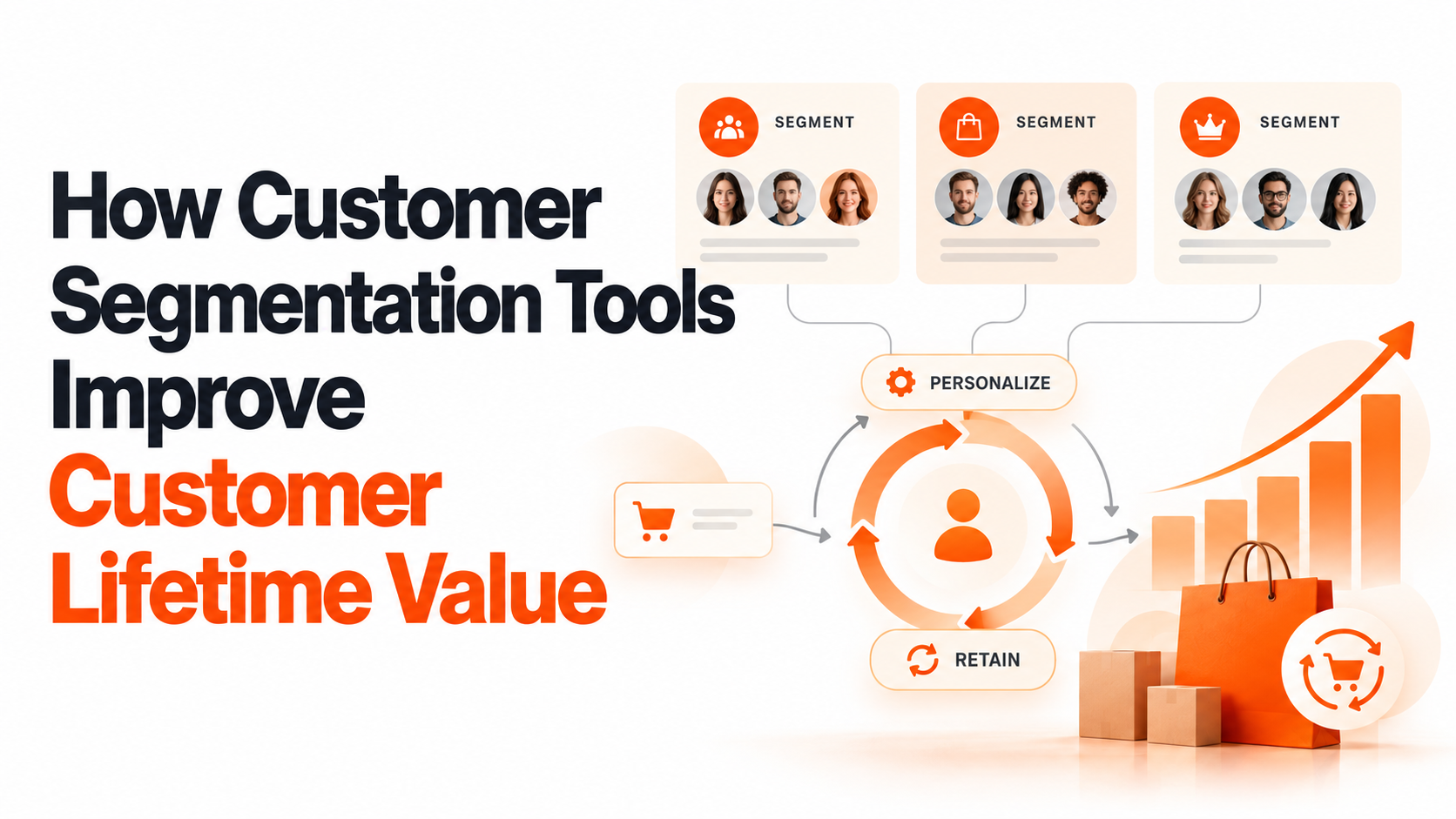
How does AI-driven audience segmentation change campaign results?
AI-driven audience segmentation groups customers by observed behavior, value, and likelihood to act, instead of by static demographics. The result is messages that fit the person receiving them. HubSpot’s 2026 report found 93.2% of marketers say personalized or segmented experiences led to more leads and purchases, while Salesforce found 51% of marketers still describe their campaigns as feeling generic. That mismatch costs conversions.
That gap is a capacity problem as much as a strategy problem. Salesforce found 78% of marketers need more personalized content than they can currently produce. AI customer behavior analysis finds the segments worth building, so a small team puts its effort where response is likeliest. Our overview of AI customer segmentation tools covers the options.
How does AI data analytics save marketing teams time and money?
AI analytics saves time by automating reporting, anomaly detection, and routine analysis. Salesforce’s high performers report reclaiming eight hours a week, and Jasper found 45% of marketers have lowered operating costs. Savings also come from consolidation, with fewer tools and fewer manual reconciliations. LayerFive says brands save $100,000 to $300,000 a year by consolidating a fragmented stack. Those are survey and vendor figures.
LayerFive also contrasts traditional stacks, which it prices at $200,000 to $850,000 a year, with plans that start at $49 a month. Those are vendor figures, so verify them against your own tool bills. Our breakdown of the $200K fragmented data problem shows how to run the numbers for your own stack. The labor savings are easier to check: if your analysts lose six hours a week to cleanup, as nearly a third of Validity’s respondents do, you can price that directly.
What does AI data analytics need before it works?
It needs a unified, first-party data foundation: consistent identities, connected ad and revenue data, and recorded consent. Without those, models learn from fragments. Gartner’s 2026 survey found 70% of CMOs say their marketing processes are not mature enough to scale AI. The fix starts below the AI layer, with data collection, identity resolution, and one agreed definition of a conversion.
Only after that foundation exists does an AI layer earn its keep. LayerFive Juno is the agentic AI product, and it works on the same unified data that Signal and Edge use, so its answers match your actual orders. LayerFive is ISO 27001 and SOC 2 Type 2 certified, which matters when an AI tool touches customer records. For the architecture, see why a unified marketing data platform gives AI tools context.
How should a marketing team start using AI data analytics?
Start small and measurable. Pick one decision, such as where to put next month’s ad budget, connect the data that decision needs, and measure the result against a baseline. Expand only after the first use case proves itself. This order matters because Jasper found only 41% of marketers can prove AI ROI today. Proof is the scarce resource. Small wins build trust.
- Choose one decision. Budget allocation, audience building, and churn prediction are good first picks.
- Audit the inputs. List every source the decision needs and test whether the numbers agree.
- Unify identity. Make sure one customer is one record across ads, store, and CRM.
- Set a baseline. Record current performance before the AI changes anything.
- Run a time-boxed test. Compare AI-guided decisions with your current method over a set period.
- Monitor data quality. Automated checks catch broken tags and duplicate records early.
- Document and expand. Write down what worked, then take on the next decision.
What does a real result look like?
Billy Footwear, a LayerFive customer, grew revenue 36% with only 7% additional ad spend. That is one brand’s outcome, not a promise for every account, and it is a vendor-reported case study, so ask any provider for comparable references. It shows the pattern worth testing: when you can see which spend produces orders, you can add budget where returns hold and trim it where they do not.
The ratio is the useful part. Revenue growth five times larger than the increase in ad spend suggests efficiency gains, not just a bigger budget. You can test the same idea on a smaller scale with one channel and one quarter of data.
What should you look for in AI-powered marketing analytics tools?
Look for tools that connect all your channels and revenue data, resolve identity from first-party data, explain their recommendations, and respect privacy rules. Ask how the tool handles bad data, since Validity’s 2026 findings show AI amplifies data problems. Ask for security certifications, and ask what happens when two sources disagree. A dashboard is not an analytics platform. Ask for specifics, not demos.
| Question to ask | Why it matters |
|---|---|
| Does it connect ad, store, and CRM data? | Seven sources is the 2026 average, and gaps hide the real picture |
| Does it resolve identity from first-party data? | Cross-device journeys break attribution when identity is missing |
| Can it explain a recommendation? | Teams act on advice they can inspect |
| How does it flag bad data? | 62% of organizations report revenue loss from poor CRM data |
| Which security certifications does it hold? | AI tools handle sensitive customer records |
| Can you measure its ROI? | Only 41% of marketers can prove AI ROI |
Frequently asked questions about AI data analytics for marketing teams
These ten questions cover definitions, benefits, risks, and next steps. Each answer stands alone, so you can read only the ones you need. Statistics come from 2026 sources linked in the list at the end of this post. Sample sizes and survey methods differ, so compare numbers across sources with care. Use the answers as a starting point, then check each source for your own context before you act.
Q: What is AI data analytics for marketing teams?
AI data analytics for marketing teams is the use of machine learning to analyze campaign, customer, and revenue data, find patterns people would miss or take days to find, and recommend or automate actions. Typical uses include attribution, forecasting, audience building, and reporting. It works best on unified first-party data, because models trained on fragmented records produce fragmented answers. It supports faster decisions.
Q: What are the main benefits of AI data analytics for marketing?
The main benefits are faster reporting, more accurate attribution, predictive audiences, better personalization, and lower costs. Salesforce’s 2026 State of Marketing reports that marketers who deploy AI effectively see 20% higher ROI, 19% lower costs, and 19% higher conversion rates. High performers also reclaim about eight hours a week. These are self-reported survey results and vary by team and data quality.
Q: How does AI marketing analytics improve ROI?
AI marketing analytics improves ROI by showing which channels and audiences produce revenue, so you move spend toward what works and away from what does not. It also reduces manual reporting hours. Salesforce’s 2026 survey found a 20% ROI increase among marketers deploying AI effectively. Jasper’s 2026 report adds a caution: only 41% of marketers can currently prove AI ROI, so measure before you scale.
Q: What is predictive analytics for marketing?
Predictive analytics for marketing uses past customer behavior to estimate future actions, such as which shoppers will buy, which customers may churn, and which offers will get a response. Marketers use those estimates to build audiences, set budgets, and time campaigns. The method needs enough clean historical data, including orders tied to the right customer profiles, to produce estimates worth trusting.
Q: How many marketers use AI in 2026?
Surveys put adoption between roughly three quarters and nine in ten marketers, depending on the sample. Salesforce’s 2026 survey of 4,450 marketers found 76% use at least one form of AI. HubSpot’s survey of more than 1,500 marketers reports 86.4%, and Jasper’s 1,400-marketer survey reports 91%. Agentic AI is less common, at 13% in the Salesforce data. Always check the sample.
Q: Can small marketing teams use AI-powered marketing analytics tools?
Yes. Small teams benefit most from automation because they have the least time for manual reporting. Start with one decision, such as budget allocation, and connect only the data it needs. LayerFive says its plans start at $49 a month, which puts unified analytics within reach of smaller brands. Confirm current pricing and limits with any vendor before you commit.
Q: Why does poor data break AI-driven marketing insights?
AI models learn from the data they receive, so errors in the input become errors in the output, often with high confidence. Validity’s 2026 survey found nearly 78% of C-suite respondents acted on an AI recommendation they later suspected was wrong because of bad data. Duplicate profiles, broken tags, and mismatched sources are the usual causes. Fix the inputs before you trust the model.
Q: How do I measure the ROI of AI data analytics?
Record a baseline before you start, run AI-guided decisions against your current method for a fixed period, and compare revenue, cost, and time spent. Track hours saved as well as revenue. Jasper’s 2026 report found 60% of teams that adapted their measurement approach report returns of two to three times or higher, so changing how you measure is part of the work.
Q: Is AI data analytics safe for customer privacy?
It can be, if you build on first-party data, record consent, limit access, and choose vendors with audited security. Poor data handling creates compliance exposure: Validity found 63% of organizations report some compliance exposure tied to poor data. Look for certifications such as ISO 27001 and SOC 2 Type 2, and review contracts with legal counsel. No tool replaces a privacy review.
Q: How does LayerFive support AI data analytics for marketing teams?
LayerFive is a unified marketing intelligence platform. Signal handles attribution and identity resolution from first-party data, Edge builds predictive audiences and activates them, and Juno is the agentic AI layer that answers questions on the same data. Because all three share one data foundation, insights match real orders. LayerFive holds ISO 27001 and SOC 2 Type 2 certifications. Ask for a demo with your own data.
What should marketing teams take from the 2026 data?
The 2026 data points one way: AI data analytics for marketing teams pays off when the data underneath it is connected and the measurement is defined, and it disappoints when teams adopt tools without either. Adoption is near universal, proof is not, and data quality explains much of the gap. The teams that connect their data first are the ones most likely to see the gains survey respondents describe.
You do not need a large project to start with AI data analytics for marketing teams. Pick one decision, connect the data behind it, set a baseline, and test. Then repeat with the next decision.
If you’re ready to stop guessing and start measuring what actually works, see how LayerFive approaches AI-driven marketing insights: LayerFive Juno.
Sources
All statistics come from the 2026 sources below. LayerFive figures (visitor identification, savings, pricing, Billy Footwear, certifications) are company-reported.
- Salesforce, State of Marketing, 10th edition (2026), 4,450 marketers: https://www.salesforce.com/au/blog/marketing-trends-ai-era/
- diginomica, Salesforce’s State of Marketing coverage, February 25, 2026: https://diginomica.com/salesforces-state-marketing-ai-dominates-agenda-data-still-holds-marketers-back
- Gartner, 2026 CMO Spend Survey, May 11, 2026, 401 marketing leaders: https://gartner.com/en/newsroom/press-releases/2026-05-11-gartner-2026-cmo-spend-survey-finds-cmos-allocate-15-point-3-percent-of-marketing-budgets-to-ai-but-only-30-percent-are-ready-to-scale-ai-capabilities
- Gartner, marketing survey on media spend, June 8, 2026: https://gcom.pdo.aws.gartner.com/en/newsroom/press-releases/2026-06-08-gartner-marketing-survey-finds-awareness-and-conversion-account-for-62-6-of-total-media-spend
- HubSpot, 2026 State of Marketing, 1,500+ marketers: https://blog.hubspot.com/marketing/inbound-marketing-data
- Jasper, State of AI in Marketing 2026, 1,400 marketers: https://jasper.ai/state-of-ai-marketing-2026
- Demand Gen Report, Validity survey of 500 marketers, September 10, 2026: https://www.demandgenreport.com/?p=54354