Quick answer
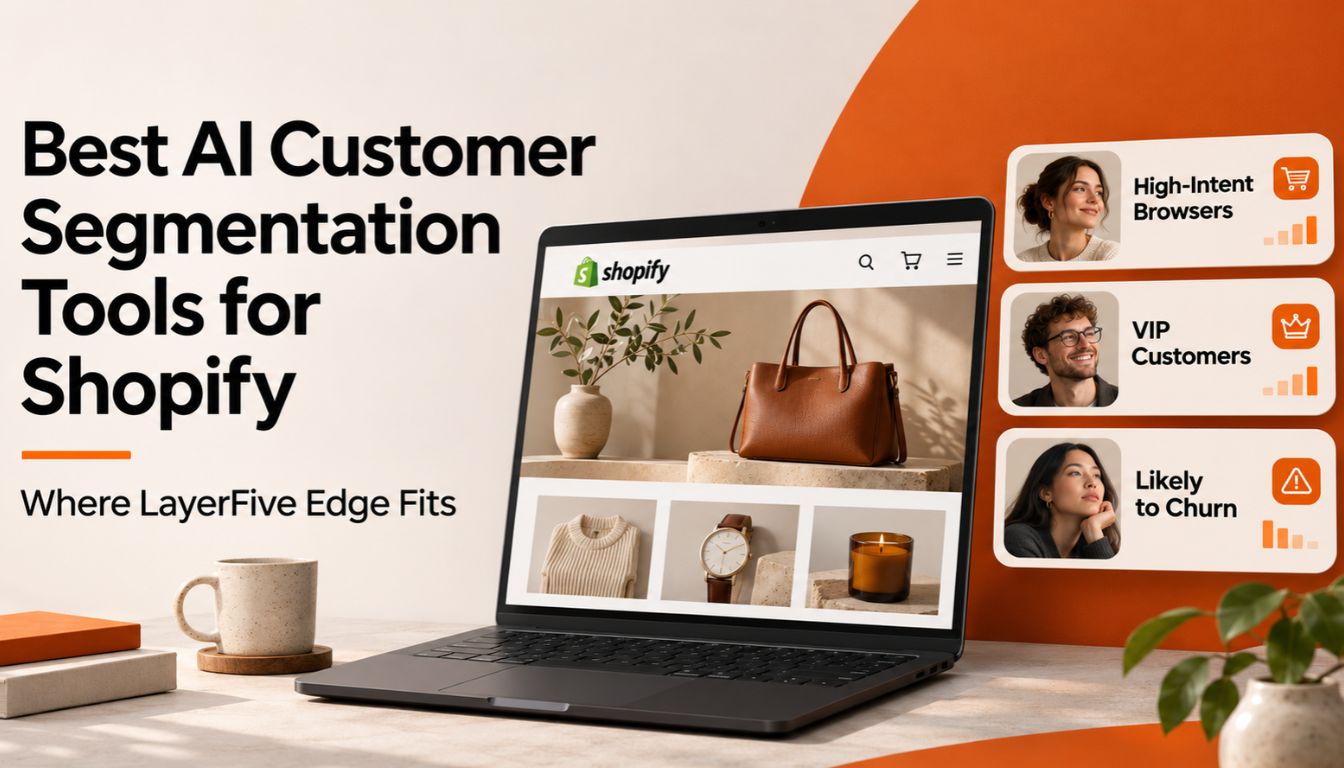
The best AI customer segmentation tool for a Shopify store depends on where your team activates audiences. Klaviyo suits email-first teams with enough order history. Analyzify and Kuma push Shopify segments to ad platforms. LayerFive Edge fits brands that want predictive audiences built from first-party visitor and customer data and sent to both Klaviyo and Meta Ads. Shopify’s built-in segments remain a sound start for simple rule-based lists. This guide compares them on data inputs, prediction, activation, and testing.
TL;DR
- Shopify’s built-in segments filter customers with rules you write. AI segmentation scores customers on likely future behavior, such as repeat purchase or churn.
- Klaviyo’s predictive analytics need at least 500 customers who have placed an order and 180 days of order history. Smaller stores may not qualify yet.
- Klaviyo syncs segments to Meta as custom audiences, but the sync is one-way, uses email addresses, and can take 24 to 48 hours to update.
- Analyzify and Kuma build segments from Shopify data and sync them to ad platforms. Kuma’s Shopify App Store listing starts at $199 per month.
- LayerFive Edge builds predictive audiences from first-party visitor and customer data and activates them in Klaviyo and Meta Ads. Confirm current capabilities on the Edge page before you buy.
- Klaviyo’s 2026 benchmarks show flows produce about 41% of email revenue from 5.3% of sends, so segment-triggered flows deserve first attention.
- Test any predictive segment with a holdout group. A 1.5-point lift on a 1,000-person holdout is not statistically conclusive.
- The IAB’s State of Data 2026 report found that 60% to 75% of buy-side users say current measurement falls short.
What are the best AI customer segmentation tools for Shopify stores?
The best AI customer segmentation tool for a Shopify store is the one that matches your activation channel and your data volume. Klaviyo works well for email and SMS teams with enough order history. Analyzify and Kuma push Shopify segments to ad platforms. LayerFive Edge targets brands that want predictive audiences built from first-party visitor and customer data and sent to both Klaviyo and Meta Ads.
Start with the question every buyer skips: where does the audience end up? A segment that lives only inside the tool that built it helps one channel. A segment that reaches email, SMS, and paid social helps the whole funnel.
LayerFive Edge is the choice for teams that want one predictive audience layer feeding Klaviyo and Meta Ads. LayerFive’s Shopify app listing shows integrations with Klaviyo, Facebook, Google, and Gorgias, plus Meta Conversions API and custom audiences. Edge is the audience product on the LayerFive platform.
Klaviyo is the default for email-led stores. Its predictive analytics forecast purchase likelihood, expected order value, and churn risk, and its Segments AI builds segments from those predictions in plain language. The constraint is data volume. Klaviyo’s help center lists a minimum of 500 customers who have placed an order.
Analyzify’s customer segments feature builds segments from Shopify data and syncs them daily to Meta, Google Ads, and Klaviyo. Kuma, listed on the Shopify App Store, adds predictive lifetime value audiences and starts at $199 per month with one audience destination on the Core plan.
Shopify’s own segments stay useful. A store with a few thousand customers and one email tool may not need a prediction layer yet. A store that runs several channels, or a Shopify Plus brand with paid social carrying real budget, usually outgrows rule-based lists first. LayerFive’s earlier guide to AI customer segmentation marketing tools covers the category basics.
How does AI customer segmentation differ from Shopify’s built-in customer segments?
Shopify’s built-in segments filter customers with rules you write, such as orders in the last 90 days or total spend above a threshold. AI segmentation scores customers on likely future behavior, such as repeat purchase or churn, then groups them automatically. Rules describe the past and need a person to set every cutoff. Predictive models estimate what happens next and update as behavior changes, though they need enough clean data.
Shopify’s developer documentation describes the segment query language as a subset of ShopifyQL that uses only the WHERE clause to filter customers by their attributes. That design is transparent. You can read a segment and know why a customer is in it.
The trade-off is maintenance. If you decide that “VIP” means three orders and $400 in spend, that cutoff stays fixed until someone revisits it. A customer who bought once but browses weekly never qualifies. A customer who bought three times two years ago still does.
AI segmentation changes the unit of work. Instead of writing the cutoff, you choose a prediction, such as likelihood to buy again in 90 days, and the model ranks every customer. Klaviyo’s guide says its predicted customer lifetime value is the amount a customer is expected to spend in the next year by default, and churn risk exports as a number between 0 and 1.
Activation is the second gap. Analyzify states that Shopify offers a Klaviyo integration but no direct sync to Meta Ads or Google Ads, and that sending audiences there needs extra workflow setup (see its Shopify versus Analyzify comparison). That is a vendor’s view, so check your own admin before you rely on it.
LayerFive’s overview of customer segmentation tools for ecommerce lists more options by store type. A practical rule: keep Shopify segments for rules you can write in one sentence. Move to predictive segments when the question is “who is most likely to,” not “who already did.”
Which Shopify segmentation tools let you send audiences to both Klaviyo and Meta Ads?
Klaviyo, Analyzify, Kuma, and LayerFive Edge can all connect audiences to Klaviyo and Meta Ads, but they differ in where the segment is built. Klaviyo syncs its own segments to Meta as custom audiences. Analyzify and Kuma build segments from Shopify data and push them out to ad platforms. Edge builds predictive audiences from first-party data and activates them in both places at once.
Klaviyo’s Meta Ads integration syncs lists and segments to Meta as custom audiences and supports lookalike audiences. It has limits worth knowing. The sync is one-way and one-to-one between a Klaviyo list or segment and a Meta audience. Klaviyo sends email addresses for Meta to match, so a profile with only a phone number is left out. Meta requires at least 100 profiles to create a custom audience, and custom audiences can take 24 to 48 hours to update.
Those limits matter for churn work. A win-back audience that updates a day or two late is acceptable. An intent audience built from a browsing session is not, because the shopper has moved on.
Analyzify and Kuma remove the Klaviyo detour. Analyzify syncs saved segments to Meta, Google Ads, or Klaviyo. Kuma’s listing names Klaviyo, Meta, Google, TikTok, and Instagram destinations. Both build from Shopify store data, so their predictions depend on what orders and customers already hold.
LayerFive Edge adds a different input. Per LayerFive’s Shopify listing, the app improves visitor recognition on your site to grow retargeting audiences and larger Klaviyo segments. Anonymous sessions can become segment members, which order-only tools cannot do.
Ask each vendor four questions before a demo. What identifies a person: email, phone, or a first-party ID? How often does the audience refresh? Is the sync one-way? What happens to a profile that has no email?
Can Shopify brands identify high-intent shoppers before their first purchase?
Yes, if the tool can recognize anonymous visitors and score their behavior before checkout. High-intent signals include repeat product views, collection depth, cart activity, and return visits within a short window. Without identification, most of these shoppers vanish from your email and ad audiences. A tool that ties sessions to a first-party profile lets you build an intent audience for the next campaign instead of retargeting only cart abandoners.
Purchase intent scoring assigns each visitor a likelihood of buying based on observed behavior. The score is only useful if it attaches to an identity you can message.
The acquisition stakes are high. In a 2026 DTC study of 468,386 orders across 17 brands, summarized by Elogic, 56.9% of revenue in the study window came from new customers’ first orders. That makes first-purchase conversion the largest revenue pool in the sample. Klaviyo’s 2026 benchmarks add that nearly 48% of flow-driven email revenue comes from new buyers, compared with 16% from campaigns.
The two findings point the same way. Welcome, browse, and abandonment flows carry first-purchase revenue, and they run on segments. A brand that can only segment people who already bought has no one to send those flows to.
Identification rate is the number to check. LayerFive reports that its visitor identification recognizes two to five times more visitors than the 5% to 15% industry standard. Treat that as LayerFive-reported and ask for the figure on your own traffic during a trial. The related visitor recognition guide explains the method.
A simple intent audience for a Shopify store might combine three or more product views in seven days, a visit to a size guide or shipping page, and no purchase. Send that group a browse flow in Klaviyo and a low-frequency Meta campaign. Exclude anyone who bought in the last 14 days.
How can Shopify stores use predictive segmentation to win back customers likely to churn?
Score existing customers on churn risk, combine that score with predicted value, and send different offers to each group. A high-value customer with rising churn risk deserves personal outreach. A low-value customer with high risk fits a cheap, automated reminder. Time the win-back before the customer goes fully quiet, and sync the same audience to Meta so email and ads do not fight each other.
Customer churn prediction estimates how likely a customer is to stop buying. Klaviyo’s model uses lifetime value, number of orders, time between orders, and the most recent order, per its churn model write-up. Its requirements are published: an ecommerce integration, 500 customers who have ordered, and 180 days of order history, according to Klaviyo Academy.
Klaviyo’s community guide proposes a simple grid. High predicted value with high churn risk gets personalized retention outreach. High value with low risk gets VIP treatment. Low value with high risk gets scalable re-engagement. The grid works in any tool that produces both scores.
The reason to bother is concentration. Rivo’s 2026 roundup of Shopify Plus retention statistics reports that repeat customers generate 44% of revenue while making up 21% of the customer base. Rivo compiles that figure from other sources, so read it as an industry indicator and not a benchmark for your store.
A workable win-back sequence runs in four steps:
- Build the audience: customers with churn risk above your chosen threshold and historic spend above a floor.
- Email first. A reminder tied to the product they last bought usually beats a blanket discount.
- Sync the same audience to Meta after seven days of email silence, and suppress anyone who reorders.
- Remove converters on the next refresh so you stop paying to reach them.
If Klaviyo cannot score your list because you are under the 500-customer threshold, a rules-based proxy works: no order in 1.5 times the customer’s own average gap between orders.
Which tools use product affinity to personalize Shopify campaigns?
Klaviyo, Kuma, and LayerFive Edge each use purchase or browse history to tie customers to products, with different depth. Product affinity modeling estimates which products or categories a shopper is most likely to buy next, based on past orders, browsing, and what similar customers bought. Rule-based tools can approximate it with SKU or collection filters. Predictive tools score it automatically.
The rule-based version is easy to start. Klaviyo’s Meta guide suggests creating segments of customers who bought specific items, filtering by item name, SKU, or collection, then syncing them to a Meta audience with ads for related products. It takes an hour and needs no model.
The predictive version ranks products per customer. Kuma’s listing describes AI that predicts what customers will buy next and builds segments from past purchases.
LayerFive Edge builds affinity from the same unified first-party profile it uses for intent and churn. The value of that design is that affinity reaches anonymous returning visitors, not only customers with an order on file. Verify current affinity features on the Edge page, since product capabilities change.
For campaign use, start narrow. Pick your three largest collections. Build one affinity audience per collection from shoppers who viewed or bought in it during the last 60 days. Send each a collection-specific email and a matching Meta creative. Compare revenue per recipient against your current all-subscribers send.
The AI audiences for Shopify guide walks through audience construction in more depth.
How does LayerFive Edge build predictive audiences from first-party visitor and customer data?
LayerFive Edge builds predictive audiences by joining first-party visitor events with Shopify customer and order data into one profile, then grouping profiles by predicted behavior such as purchase intent, repeat purchase, or churn. The team picks an audience, reviews its size and composition, and activates it in Klaviyo and Meta Ads. The audience refreshes as new behavior arrives, so it stays current between campaigns.
The workflow starts with data the brand already owns. Inputs are Shopify orders and customers, onsite visitor behavior captured through LayerFive’s tracking, and engagement from connected tools such as Klaviyo. Signal, LayerFive’s first-party identity and attribution product, handles the identity step, so sessions and orders resolve to the same person where the data allows.
Edge then forms the predictive audience. Examples include visitors with high purchase intent who have not bought, first-time buyers likely to reorder, and lapsed customers likely to churn. The team sees the audience before sending it, which lets a marketer sanity-check size and overlap.
Activation is the payoff. The same audience can enrich Klaviyo segments for flows and reach Meta as a custom audience, supported by Conversions API data. That removes the export-and-upload step where audiences usually go stale.
The decision it supports is budget allocation by audience quality. A team can fund a win-back audience at higher bids than a cold lookalike, because it knows which group is most likely to return.
LayerFive reports a Billy Footwear result of 36% revenue growth on 7% additional ad spend. The metric definition and period belong to LayerFive’s case documentation, so request the baseline before quoting it in your own plan. On security, LayerFive states ISO 27001 and SOC 2 Type 2 certification, which matters when you pass customer data to a third party.
If your main problem is that channel data and dashboards disagree, start with Axis, the unified reporting product, before adding audiences. Edge works best on a clean measurement base.
How can a Shopify brand test whether predictive segments increase repeat purchases and revenue?
Use a holdout test. Randomly split a predictive audience into a treatment group that gets the campaign and a holdout that does not, run both for a fixed window such as 90 days, then compare repeat purchase rate and revenue per customer. The difference between groups is your incremental result. Without a holdout, you only learn how the segment performed, not whether the segment caused it.
Measurement discipline is scarce. The IAB’s State of Data 2026 surveyed more than 400 senior planning and analytics decision-makers at US brands and agencies, and a sponsor summary reports that 60% to 75% of users say current advanced measurement solutions fall short on rigor, timeliness, trust, and efficiency. A holdout is the cheapest fix for the rigor gap.
Here is a worked example with hypothetical numbers. Say a store scores 5,000 customers as likely to churn. It sends 4,000 into a win-back flow and holds out 1,000.
Hypothetical results after 90 days: the holdout repeat purchase rate is 8.0%, and the treated rate is 9.5%. The lift is 1.5 percentage points, or about 60 extra repeat buyers among the 4,000. At an assumed $85 average order value, incremental revenue is roughly $5,100 before discount and email costs.
Now check significance. The standard error of the difference is about 0.98 points, so the z-score is about 1.5. That is below the common 1.96 threshold for 95% confidence. The result is promising but not proof. Either run longer, enlarge the holdout, or treat the finding as directional.
Track four metrics: repeat purchase rate in the window, revenue per customer, margin after discounts, and unsubscribe or complaint rate. Report them by treatment and holdout, never blended.
Run the test in one channel first. Test Klaviyo-only, then add Meta, so you can see what each channel adds. Use Axis or your existing reporting to keep both groups in one view. Interconnections’ 2026 DTC study, summarized by Elogic, found 10.2% of window revenue came from repeat orders by customers acquired in the window, a useful sanity check on your own repeat share.
What should you do next?
Shortlist two tools, define one audience, and run a 90-day holdout before committing budget. Pick the churn win-back audience if you already have order history, or the high-intent audience if traffic is your bigger asset. Compare tools on the four routing questions above. If you want predictive audiences that reach Klaviyo and Meta Ads from first-party data, explore LayerFive Edge or book a demo.
Related reading on LayerFive: the Shopify marketing analytics tool guide covers the Klaviyo and Meta stack, and the predictive analytics guide for Shopify brands covers forecasting. For the definitions behind this comparison, see the first-party data guide for Shopify.
Explore LayerFive Edge or book a demo.
Frequently asked questions
These ten questions cover the points Shopify buyers raise most often when they compare segmentation tools. Each answer stands on its own, so you can jump straight to the one that matches your situation and your current stack. Figures are sourced in the article above. Product capabilities and prices change, so confirm them on each vendor’s current documentation before you decide.
What is AI customer segmentation for Shopify?
AI customer segmentation for Shopify uses machine learning to group customers by predicted behavior, such as likelihood to buy again or to churn, instead of fixed rules. It reads order history, product activity, and engagement, scores each customer, and updates groups as behavior changes. The output is an audience you can send to email, SMS, or paid social, not only a report.
Do I need AI segmentation if I already use Shopify segments and Klaviyo?
Not always. Shopify segments plus Klaviyo handle many stores well, especially those with fewer than a few thousand customers and one main channel. Consider AI segmentation when you run several channels, when rules need constant manual updates, or when you want audiences based on predicted behavior and anonymous visitor activity. Start with one audience and a holdout test before you expand.
How much data does Klaviyo need for predictive analytics?
Klaviyo’s published requirements include an active ecommerce integration, at least 500 customers who have placed an order, and at least 180 days of order history. Some customers also need to have ordered three or more times. If your account falls short, predictive fields may appear blank, and a rules-based proxy such as time since last order is a reasonable substitute.
Can Shopify send customer segments directly to Meta Ads?
Shopify’s own segments do not include a documented direct sync to Meta Ads, according to Analyzify’s comparison, which is a vendor source. Common routes are Klaviyo’s Meta Ads integration, which syncs segments as custom audiences, or apps such as Analyzify, Kuma, and LayerFive. Confirm what your own Shopify admin and installed apps support before you plan a workflow around it, because integrations change often.
Which Shopify segmentation tool is best for Shopify Plus brands?
No single tool wins for every Plus brand. Klaviyo is a strong base for email and SMS. Analyzify and Kuma suit teams that want Shopify-based segments synced to ad platforms. LayerFive Edge fits brands that want predictive audiences from first-party visitor and customer data across Klaviyo and Meta Ads. Choose by activation channels, identity needs, and how you plan to measure incrementality.
How do I find high-intent visitors before they buy?
Track behavior that signals interest, such as repeat product views, collection depth, size guide visits, and returning sessions within a week. Then tie those sessions to a first-party identity so you can message the visitor later. Without identification, intent stays invisible to your email and ad tools. Build one intent audience, exclude recent buyers, and measure it against a holdout.
Can I build a churn win-back audience without a data science team?
Yes. Klaviyo produces a churn risk score without custom modeling once your account meets its data requirements, and tools like LayerFive Edge build churn-oriented audiences from first-party data. Combine the score with spend, so you invest more in your most valuable customers. If you lack data, use a proxy: no order within one and a half times the customer’s usual gap.
What is product affinity modeling in ecommerce?
Product affinity modeling estimates which products or categories a customer is most likely to buy next, using past purchases, browsing, and the behavior of similar shoppers. Teams use it to pick which product to feature in email, which creative to show on Meta, and which cross-sell to suggest. A simple version filters by collection or SKU, and predictive versions rank products per customer.
How long does it take to see results from predictive segments?
Plan on a 90-day window for repeat purchase measurement, with early reads on click and revenue per recipient after two to four weeks. Meta custom audiences can take 24 to 48 hours to update after a Klaviyo sync, so allow for that delay. Short tests often lack the sample size to reach significance, so size the holdout before you start.
Is predictive segmentation safe for customer privacy?
It can be, if the tool uses first-party data you have permission to use, honors consent choices, and meets recognized security standards. Ask vendors how they handle consent choices, how long they retain data, and whether they delete records on request. Confirm where data is stored and who can access it. LayerFive states ISO 27001 and SOC 2 Type 2 certification, and any vendor should show proof.
Sources
- IAB, State of Data 2026 (February 2026): https://www.iab.com/state-of-data
- Dstillery release on IAB State of Data 2026, February 26, 2026: https://www.globenewswire.com/fr/news-release/2026/02/26/3245580/0/en/dstillery-sponsors-iab-state-of-data-2026.html
- Klaviyo 2026 email marketing benchmarks: https://www.klaviyo.com/blog/email-marketing-data
- Klaviyo benchmarks page (flows share of revenue): https://klaviyo.com/au/products/email-marketing/benchmarks
- Klaviyo predictive segmentation: https://www.klaviyo.com/composer/predictive-segmentation
- Klaviyo predictive analytics guide: https://help.klaviyo.com/hc/en-us/articles/360020919731
- Klaviyo Academy, predictive analytics prerequisites: https://academy.klaviyo.com/en-us/courses/getting-started-with-marketing-analytics/lessons/custom-clv
- Klaviyo churn model: https://www.klaviyo.com/blog/predicting-churn-risk-our-new-model
- Klaviyo Meta Ads integration: https://help.klaviyo.com/hc/en-us/articles/115005082127
- Klaviyo Meta audience sync strategy: https://help.klaviyo.com/hc/en-us/articles/360040954011
- Klaviyo Meta integration timing: https://help.klaviyo.com/hc/en-us/articles/360022709151-Integrate-with-Facebook
- Klaviyo community, predicted CLV segments: https://community.klaviyo.com/analytics-72/predicted-clv-in-klaviyo-how-it-works-and-how-to-build-a-segment-19841
- Shopify segment query language reference: https://shopify.dev/docs/api/shopifyql/segment-query-language-reference
- Analyzify, Shopify segments vs Analyzify: https://analyzify.com/hub/shopify-segments-vs-analyzify
- Analyzify customer segments: https://analyzify.com/features/customer-segments
- Kuma on the Shopify App Store: https://apps.shopify.com/kuma
- LayerFive Audience & Analytics on the Shopify App Store: https://apps.shopify.com/layerfive-consumer-management
- Elogic, ecommerce CAC and retention statistics 2026 (Interconnections DTC study): https://elogic.co/?p=476803
- Rivo, Shopify Plus retention statistics 2026: https://www.rivo.io/blog/shopify-dtc-brand-retention-statistics