Quick answer
The best Shopify marketing attribution tools in 2027 are the ones that show how much of each customer journey they actually see. Shopify Analytics and GA4 are the free baselines. Triple Whale, Northbeam, Polar Analytics and Rockerbox cover paid-media attribution at different budgets. LayerFive Signal suits brands that want first-party identity resolution feeding multi-touch attribution. Choose by identity coverage, visible credit rules and agreement with Shopify orders.
TL;DR
- Shopify, Meta Ads and Google Ads count conversions by different rules, so their totals rarely match Shopify orders.
- A dedicated attribution tool pays off once you run several paid channels plus email and move budget based on channel ROAS.
- Judge tools on identity coverage, transparent credit rules, order-level reconciliation and the quality of signals sent back to ad platforms.
- Confidence in measurement is low in 2026 research: up to 75% of US buy-side leaders say attribution, incrementality and media mix models fall short (IAB State of Data 2026).
- LayerFive Signal pairs the L5 Pixel with identity resolution and multi-touch attribution. Axis handles reporting, Edge handles audience activation and Juno handles monitoring.
- LayerFive-reported results, such as Billy Footwear’s 36% revenue growth on 7% more ad spend, come from the brand itself. Test any vendor on your own traffic.
What are the best Shopify marketing attribution tools in 2027?
The best Shopify marketing attribution tools in 2027 fall into three groups: free native reporting (Shopify Analytics and GA4), paid attribution suites (Triple Whale, Northbeam, Polar Analytics, Rockerbox and Hyros), and unified platforms that resolve identity before they assign credit (LayerFive Signal). The right group depends on ad spend, channel count and how much of each journey your current tools can see.
Shopify Analytics is the starting point because it counts real orders. Its marketing reports offer five attribution models: last non-direct click (the default in marketing views), last click, first click, any click and linear (Shopify Help Center). The Spring 2026 Edition added Insights, chart annotations, metafield filters, metric targets and a Flow action that runs scheduled ShopifyQL queries (Shopify, June 17, 2026). All five attribution models allocate credit across the clicks and visits Shopify records.
GA4 is free and connects to Google Ads. Its key event lookback windows default to 30 days for acquisition events and 90 days for other key events (Google Analytics Help). It reports sessions and users, not a resolved customer profile that you control.
Triple Whale is built around Shopify. Its Triple Pixel is a proprietary pixel backed by an identity graph and server-side collection (Triple Whale). Northbeam focuses on machine-learning multi-touch attribution and media mix modeling for high-spend brands, and two 2026 reviews put its entry price at $1,500 per month (ThoughtMetric, May 2026; Taylor Sicard, July 2026). Polar Analytics pairs dashboards, a first-party pixel and a dedicated Snowflake warehouse for each customer. Rockerbox combines multi-touch attribution, media mix modeling and incrementality testing across online and offline channels, with quote-based pricing. Hyros targets long sales cycles and phone-based sales, according to Cometly’s 2026 comparison.
LayerFive Signal is LayerFive’s attribution and identity product. It collects first-party events through the L5 Pixel, resolves visitors with deterministic and probabilistic matching, and runs multi-touch attribution, media mix modeling and journey analysis on the resolved data. The sections below show where that fits and where it does not.
How should Shopify brands choose marketing attribution software?
Choose marketing attribution software by running a pilot that tests five things: how many visitors the tool can identify, whether you can inspect its credit rules, whether its order totals match Shopify, whether it sends cleaner conversion signals back to Meta and Google, and what setup demands from your team. Rank vendors on those results before you compare dashboards or feature lists.
Identity coverage comes first because a model can only divide credit among touches it observed. The 2026 AgencyAnalytics benchmark of 494 agency professionals found that 47% struggle to attribute conversions across multi-session journeys, and 44% question the reliability of traditional attribution models as privacy changes erode their inputs (AgencyAnalytics, July 2026). Ask each vendor for an identification rate measured on your own traffic, not an industry average.
Transparency comes second. SegmentStream’s May 2026 buying guide tells Shopify buyers to ask how credit is assigned and what inputs go into the model (SegmentStream). A tool that cannot show its rules cannot defend a budget move to your finance lead.
Reconciliation is third. Attributed orders should never exceed Shopify orders for the same period and definition. Shopify’s own documentation says each platform credits sales by its own rules, so one sale can be counted by several of them (Shopify Help Center).
Signal quality is fourth. Ask whether the tool sends server-side conversion events back to Meta and Google, since both platforms optimize on the events they receive. Setup effort is fifth: count the hours your team spends on tagging, UTM cleanup and manual exports.
Finally, validate the winner. In the IAB’s February 2026 survey, 76% of US buy-side decision-makers used incrementality tests and 73% used attribution analysis, yet only 39% combined attribution, incrementality and media mix models (B&T, citing IAB). A Shopify brand can approximate that discipline cheaply by shifting 10% of a channel’s budget for two weeks and checking blended revenue.
When should a Shopify store add a dedicated attribution tool to Shopify Analytics and GA4?
Add a dedicated attribution tool when you run at least two paid channels plus email, platform-reported conversions add up to more than your Shopify orders, and budget moves depend on channel ROAS. Below that point, Shopify Analytics, GA4 and consistent UTM tags usually answer the question. Above it, you need a credit-per-order view that includes touches the free tools cannot see.
Hackceleration’s 2026 roundup makes the same cut: when ad spend is only a few thousand dollars a month, GA4 and clean UTM tags do the job, and a paid tool earns its place above that (Hackceleration). Data volume matters too. Google recommends at least 200 conversions and 2,000 ad interactions in a 30-day period for data-driven attribution to work well (Google Ads Help), and that model is the default for most conversion actions (Google Ads Help). Smaller stores may get thinner models inside Google Ads than they assume.
Budget pressure raises the stakes. Gartner’s 2026 CMO Spend Survey of 401 leaders found marketing budgets flat at 7.8% of company revenue, with 56% of CMOs saying they lack the budget to deliver their 2026 strategy (MarTech on Gartner). Most respondents work at companies above $1 billion in revenue, so read the figures as directional for DTC brands. The practical point holds: when budgets are flat, misallocated spend cannot be covered by growth.
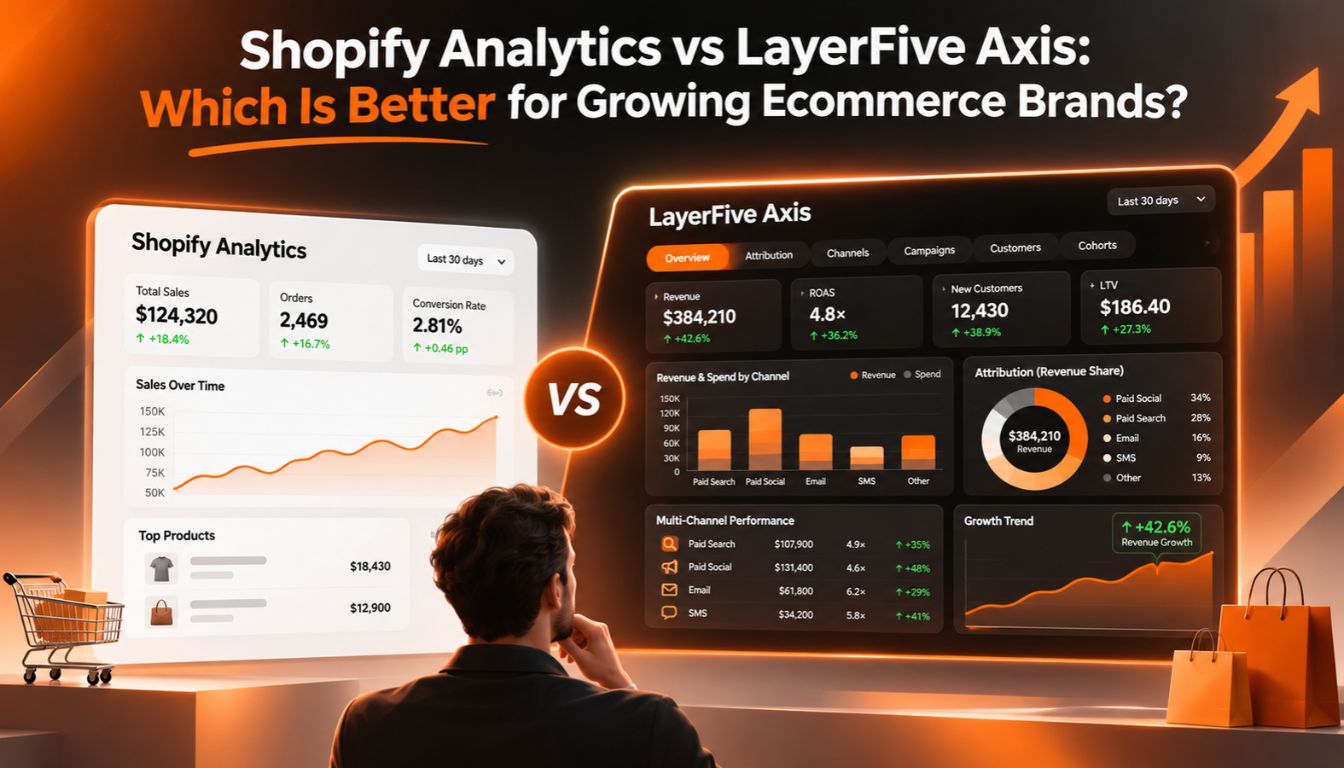
For a side-by-side of native reporting and a unified layer, see LayerFive’s comparison of Shopify Analytics and LayerFive Axis.
How does multi-touch attribution differ from last-click attribution for Shopify stores?
Last-click attribution gives 100% of an order’s credit to one touchpoint, while multi-touch attribution spreads credit across the touchpoints that came before the order. Last-click favors channels that close sales, such as branded search and email. Multi-touch shows which channels start or assist journeys, but it needs enough identified visitors to see those earlier touches. The right choice depends on which budget decision you are trying to make.
Shopify’s marketing views default to last non-direct click, which skips direct visits and credits the final marketing click. Consider a hypothetical $120 order. A shopper clicks a Meta ad on Monday, searches the brand on Google on Wednesday and buys from a Klaviyo email on Friday.
Under last click, email receives $120 and Meta and Google receive $0. Under first click, Meta receives $120. Under linear, each channel receives $40. Under a position-based model with 40%, 20% and 40% weights (Shopify), Meta receives $48, Google $24 and email $48. Shopify’s any click model credits all three channels with the full $120, which totals $360 for one order. Shopify says that model suits single-channel analysis and reconciling channel claims rather than judging a channel mix (Shopify Help Center).
Multi-touch only works when the tool recorded the touches. If the Monday visit happened on a phone and the Friday click on a laptop, a tool without identity resolution sees two people and gives all the credit to email. LayerFive’s guides on seven attribution models and multi-touch attribution for Shopify cover the mechanics in more depth.
Why do Shopify, Meta Ads, and Google Ads report different conversion totals?
Shopify, Meta Ads and Google Ads report different totals because each applies its own attribution window and credit rule, and none sees the others’ claims. Shopify credits an order to one channel under the model you choose. Meta and Google each count any conversion their ads touched inside their windows, so one order can appear in both platforms and in your email tool.
Meta’s default setting for website conversions is 7-day click, 1-day engage-through and 1-day view (Dataslayer). Since January 12, 2026, Meta no longer returns 7-day view or 28-day view windows (Supermetrics documentation; Dataslayer), so comparisons across that date measure different things. Google Ads applies a 30-day click conversion window by default for Search and Display campaigns (Google Ads Help).
The gap can be large. Visionary Marketing, a UK agency, compared platform conversions with backend totals for 240 client accounts in a 2026 study and reported Meta 24% and Google Ads 18% above backend figures (Visionary Marketing). The study is agency-run, its panel survey had 2,400 respondents, and it does not state the exact formula, so treat the numbers as directional.
These gaps are structural. LayerFive describes them as the Shopify attribution gap, caused by identity loss, fragmented journeys and conflicting platform reports (Shopify attribution gap).
What should a Shopify team reconcile before moving spend between Google Ads and Meta?
Before moving spend between Google Ads and Meta, reconcile five inputs: Shopify orders and revenue, each platform’s claimed conversions, the attribution windows behind those claims, email-attributed orders, and a blended efficiency ratio (revenue divided by total ad spend). If the platform claims add up to more than Shopify orders, resolve that overlap first. Only then compare ROAS between the two channels.
The numbers below are hypothetical and exist only to show the arithmetic. A store spent $40,000 on Meta and $30,000 on Google Ads in one month. Shopify recorded 2,400 orders and $216,000 in revenue, an average order value of $90. Meta reported 1,300 purchases worth $117,000, Google Ads reported 1,100 conversions worth $99,000, and Klaviyo reported 700 orders worth $63,000. The three sources together claimed 3,100 orders, 29% more than Shopify recorded. On those claims, Meta shows a 2.9x ROAS and Google 3.3x, which points toward moving money to Google.
- Match definitions. Use the same date range, time zone and revenue basis in every system.
- Sum the platform claims and compare them with Shopify orders. The 700 surplus orders in the example are overlap.
- Assign each order once. Pick one stated model and apply it to first-party journey data. Suppose the result is Meta 900 orders, Google 800, email 500 and other sources 200, which totals 2,400.
- Recompute ROAS. Meta falls to $81,000 on $40,000 of spend, or 2.0x. Google falls to $72,000 on $30,000, or 2.4x. The blended ratio is $216,000 on $70,000, or 3.1x.
- Test before you commit. Google still looks stronger, but if Meta starts journeys that Google closes, cutting Meta also lowers Google’s results. Shift 10% of budget for two weeks, or hold out one region, and compare blended revenue.
How do first-party tracking and customer identity resolution help Shopify brands measure cross-channel conversions?
First-party tracking collects visits and purchases on your own domain, and customer identity resolution links those events to the same person across sessions and devices. Together they let an attribution model read a journey as one path instead of three anonymous visits. That raises the share of orders tied to a real source and reduces the share that fall into direct traffic.
Identity resolution works in two ways. Deterministic matching joins events through identifiers a customer shared, such as an email address, phone number or login. Probabilistic matching infers links from device and behavior signals when no identifier exists. LayerFive’s guide to identity resolution in marketing analytics explains both.
The 2026 evidence shows why this matters. In the AgencyAnalytics benchmark, 47% of agencies cited multi-session attribution as a challenge because users research across devices over weeks and cookies do not last that long, 45% cited identifying content’s influence on conversions, and 48% cited tracking discovery through AI tools that leaves no referral data (AgencyAnalytics). The IAB’s February 2026 report found that 60% to 75% of advanced-measurement users say their methods fall short on rigor, timeliness, trust and efficiency (IAB release via GlobeNewswire).
LayerFive reports that Signal identifies 2 to 5 times more visitors than the 5% to 15% industry standard. That figure is LayerFive’s own. A 2026 independent review stress-tested it and advised buyers to confirm privacy and legal details with LayerFive before deploying (Influencers Time). Run a pilot on your store and measure the identification rate yourself.
How does LayerFive Signal connect customer identity with marketing attribution for Shopify brands?
LayerFive Signal collects first-party events with the L5 Pixel, matches visitors across sessions and devices using deterministic and probabilistic methods, then runs multi-touch attribution on those resolved journeys and checks the results against Shopify orders. Axis supplies the unified spend and revenue data underneath. The sequence is identity first and credit second, which reverses tools that start from ad-platform reports.
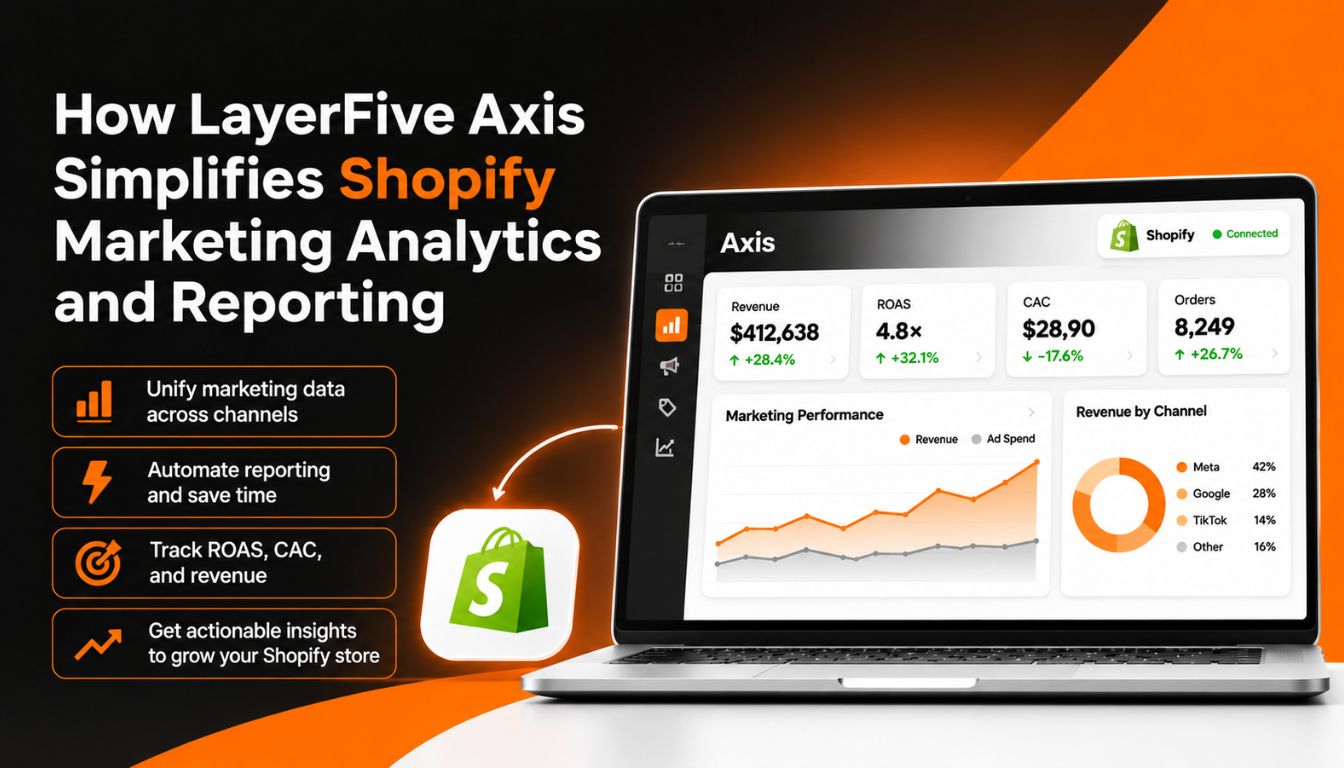
Start with the data a Shopify brand already has: orders in Shopify, spend and conversions in Meta Ads and Google Ads, and email revenue in Klaviyo. LayerFive Axis connects those sources and reports spend against actual store revenue. Signal then adds the L5 Pixel, identity resolution, attribution modeling, media mix modeling and funnel analytics, according to LayerFive’s Shopify attribution gap guide. LayerFive lists a Shopify app, LayerFive Audience & Analytics, in the Shopify App Store.
The team sees channel contribution, customer journeys and assisted conversions. The decision it supports is concrete: whether Meta’s reported ROAS holds up once overlapping credit is removed, and whether Google’s brand-search results reflect demand that another channel created.
LayerFive states that most Shopify brands can install the L5 Pixel and configure server-side conversion feeds within an hour, with identity data typically filling in over the first 7 to 14 days. After attribution is trusted, Edge builds and activates customer segments, and Juno, formerly called Navigator, adds AI agents that flag anomalies such as abnormal CAC or ROAS. LayerFive is ISO 27001 and SOC 2 Type 2 certified, and plans start at $49 per month, according to its Axis comparison page.
In LayerFive’s case study, Billy Footwear grew revenue 36% with only 7% additional ad spend after adopting the platform. LayerFive reported that result. It depends on channel mix, margins and starting data quality, so treat it as an example of what is possible and not as a forecast.
How do the leading Shopify attribution tools compare on the same criteria?
Compared on identity method, attribution methods, reporting effort, activation and implementation, the leading Shopify attribution tools differ more in scope than in model math. LayerFive Signal is built around identity-first attribution and stack consolidation, Triple Whale around fast Shopify dashboards, Northbeam and Rockerbox around modeling depth for larger budgets, Polar Analytics around BI and warehousing, and GA4 around free traffic reporting.
On identity method, Signal resolves visitors with deterministic and probabilistic matching on L5 Pixel data. Triple Whale uses its Triple Pixel with an identity graph. A vendor comparison from Admetrics, checked in August 2026, describes Northbeam as a browser-pixel tool with seven attribution models plus view-through, and Polar as offering a Polar Pixel with ten models (Admetrics). Admetrics sells a competing product, so verify these details in each vendor’s documentation.
On attribution methods, Signal offers multi-touch attribution, media mix modeling and incrementality-style analysis, according to LayerFive. Northbeam offers multi-touch attribution and media mix modeling. Rockerbox adds incrementality testing and offline channels. On reporting effort, Axis connects Shopify, Meta Ads, Google Ads and other sources into one dashboard, while Polar’s dedicated warehouse suits teams that want raw data access.
On activation, Triple Whale offers Klaviyo flow enrichment through Sonar Send, and Edge builds predictive audiences for activation. On cost, Northbeam’s entry price is reported at $1,500 per month, Rockerbox uses custom quotes, and Polar’s pricing varies across 2026 sources, so confirm it on the vendor’s pricing page. LayerFive plans start at $49 per month for Axis.
Another approach is enough in several cases. A store with one paid channel can stay on Shopify Analytics, GA4 and UTM tags. A brand with large offline media may prefer Rockerbox. A team that wants a warehouse may prefer Polar, and a business selling by phone may prefer Hyros. LayerFive’s broader Shopify attribution platform comparison covers more of these trade-offs.
Where does LayerFive Signal fit for Shopify brands running Meta Ads, Google Ads, and email campaigns?
LayerFive Signal fits Shopify brands that run Meta Ads, Google Ads and email together and cannot get the three to agree with Shopify orders. It resolves visitors across those channels, assigns credit with multi-touch attribution, and shows which channel starts, assists and closes journeys. It fits less well for stores with one paid channel, low traffic or measurement needs centered on offline media.
Take a brand that prospects on Meta, captures brand search on Google and converts through Klaviyo flows. Platform reports each claim the same buyers. Signal’s job is to show the path those buyers took, so the team can fund the channel that starts journeys without starving the one that closes them. An agency managing many stores starts with Axis dashboards and adds Signal where clients dispute channel credit.
The practical next step is the reconciliation above. Export last month’s Shopify orders and each platform’s conversion counts, find the overlap, and ask any vendor to reproduce your Shopify total in a pilot. To see Signal run on your own data, book a LayerFive demo.
Frequently asked questions
What are the best marketing attribution tools for Shopify brands in 2027?
The best marketing attribution tools for Shopify brands in 2027 depend on spend and channel mix. Shopify Analytics and GA4 are free baselines, Triple Whale suits Shopify-first dashboards, Northbeam and Rockerbox suit larger budgets, Polar Analytics suits teams that want BI and a warehouse, and LayerFive Signal suits brands that want first-party identity resolution behind multi-touch attribution. Run a pilot against your Shopify orders before committing.
What is Shopify marketing attribution software?
Shopify marketing attribution software connects your store orders to the ads, emails and organic visits that came before them, then assigns each order’s revenue to channels using a stated rule. It replaces the separate conversion counts that Meta, Google and Klaviyo report with one view. Better tools also resolve visitors across devices and send cleaner conversion events back to ad platforms for optimization.
Does Shopify have built-in marketing attribution?
Yes. Shopify’s marketing reports include five attribution models: last non-direct click, last click, first click, any click and linear, with last non-direct click as the default in marketing views. Shopify counts real orders, which makes it the right source for revenue totals. It records the visits and clicks it can see, so journeys that cross devices or browsers unrecognized stay incomplete.
Source: Shopify Help Center
Is GA4 enough for Shopify attribution?
GA4 is enough for traffic trends and basic channel reporting on small ad budgets, and it is free. It gets weaker when you run several paid channels plus email and need one order-level view tied to Shopify revenue. GA4 and Shopify count sessions and attribute sales differently, so treat Shopify as the source for orders and GA4 as the source for behavior.
Source: First Pier, 2026 Shopify analytics guide
Should I trust Meta’s ROAS or Shopify’s revenue?
Trust Shopify for how many orders and how much revenue you received, and treat Meta’s ROAS as a platform claim that includes view-through and engage-through credit inside its own window. Meta’s default setting is 7-day click, 1-day engage-through and 1-day view. Compare Meta’s claim with a first-party view and a blended efficiency ratio, which is total revenue divided by total ad spend, before changing budgets.
Source: Dataslayer
What is first-party attribution software for Shopify?
First-party attribution software for Shopify measures marketing performance with data your business collects on its own domain, such as pixel events, orders and email identifiers, instead of relying only on third-party cookies or ad-platform reports. It ties touchpoints to customer identities where consent and identifiers allow, then assigns credit with a stated model. LayerFive Signal and Triple Whale both take a first-party approach, using different methods.
How long does it take to set up LayerFive Signal on Shopify?
LayerFive says most Shopify brands can install the L5 Pixel, configure server-side conversion feeds and see attributed performance within about an hour of signup. Identity resolution data then builds as traffic flows through the pixel, typically over the first 7 to 14 days. Treat those as vendor-stated timelines and confirm them during a trial on your own store before you rely on them.
Source: LayerFive, Shopify attribution gap
How does LayerFive Signal compare with Triple Whale and Northbeam?
Signal starts from first-party identity resolution and runs multi-touch attribution, media mix modeling and journey analysis on resolved visitors. Triple Whale centers on Shopify dashboards built around its own pixel, and Northbeam centers on machine-learning attribution and media mix modeling for larger spenders. The fair test is a pilot that compares identified visitors and order reconciliation on the same store over the same dates.
What is cross-channel conversion tracking?
Cross-channel conversion tracking follows a purchase back through every channel a customer touched, such as a Meta ad, a Google search and a Klaviyo email, and records each touch against one customer. It depends on consistent UTM tags, a first-party pixel and identity resolution to join sessions. Without it, each platform reports its own conversions and the totals overlap, which inflates return on ad spend.
What are the limits of marketing attribution tools?
Attribution tools estimate credit and do not prove cause. Models differ, some touches such as podcasts or word of mouth leave no trace, and AI-driven discovery often arrives without source data, which 48% of agencies in the 2026 AgencyAnalytics benchmark called a challenge. Validate any tool with holdout tests or a controlled budget shift, and use post-purchase surveys to capture channels the tracking cannot see.
Source: AgencyAnalytics
Sources
Research and documentation (2026 unless noted as documentation):
- IAB State of Data 2026 landing page: https://www.iab.com/state-of-data
- IAB State of Data 2026 report PDF (mirror hosted by MediaPost): https://s3.amazonaws.com/media.mediapost.com/uploads/IAB_StateofDataReport_February_2026pdf.pdf
- IAB release via GlobeNewswire, February 26, 2026: https://www.globenewswire.com/fr/news-release/2026/02/26/3245580/0/en/dstillery-sponsors-iab-state-of-data-2026.html
- B&T on the 39% combined-use finding: https://www.bandt.com.au/measurement-at-critical-juncture-as-marketers-have-confidence-on-individual-channels-less-clarity-on-overall-advertising-impact/
- MarTech on the IAB finding that 75% say measurement falls short: https://martech.org/75-of-marketers-say-their-measurement-systems-are-falling-short/
- AgencyAnalytics 2026 Agency Benchmarks (n=494, February to April 2026): https://agencyanalytics.com/blog/agency-benchmarks-2026-attribution
- Gartner 2026 CMO Spend Survey press release, May 11, 2026: https://www.gartner.com/en/newsroom/press-releases/2026-05-11-gartner-2026-cmo-spend-survey-finds-cmos-allocate-15-point-3-percent-of-marketing-budgets-to-ai-but-only-30-percent-are-ready-to-scale-ai-capabilities
- MarTech on the Gartner survey: https://martech.org/cmos-are-buying-ai-that-their-organization-isnt-ready-for/
- Visionary Marketing attribution study (agency-run): https://visionary-marketing.co.uk/blog/marketing-attribution-statistics-2026
- Hackceleration attribution software roundup: https://hackceleration.com/labs/best/marketing-attribution-software
- SegmentStream guide, May 15, 2026: https://segmentstream.com/blog/articles/best-attribution-tools-for-shopify
- First Pier Shopify analytics guide: https://firstpier.com/resources/shopify-reporting
- Influencers Time review of the LayerFive Signal identification claim: https://www.influencers-time.com/layerfive-signal-2-5x-match-rate-claim-verified-or-hype/
Platform documentation:
- Shopify Help Center, marketing reports: https://help.shopify.com/en/manual/reports-and-analytics/shopify-reports/report-types/default-reports/marketing-reports
- Shopify Help Center, measuring marketing performance: https://help.shopify.com/en/manual/promoting-marketing/analyze-marketing/marketing-performance
- Shopify, Analytics in the Spring 2026 Edition, June 17, 2026: https://www.shopify.com/blog/analytics-spring-2026
- Shopify, marketing attribution models: https://www.shopify.com/blog/marketing-attribution
- Google Ads Help, data-driven attribution: https://support.google.com/google-ads/answer/6394265?hl=en
- Google Ads Help, attribution models: https://support.google.com/google-ads/answer/6259715?hl=en
- Google Ads Help, conversion windows: https://support.google.com/google-ads/answer/3123169?hl=en
- Google Analytics Help, attribution settings: https://support.google.com/analytics/answer/10597962?hl=en
- Supermetrics documentation on Meta changes effective January 12, 2026: https://docs.supermetrics.com/docs/facebook-ads-new-historical-limitations-attribution-window-and-metric-removals-january-12-2026
- Dataslayer on Meta’s removed view windows: https://www.dataslayer.ai/blog/meta-ads-attribution-window-removed-january-2026
- Dataslayer on Meta’s engage-through default: https://www.dataslayer.ai/blog/meta-attribution-change-2026-what-engage-through-attribution-is-and-why-your-numbers-look-different