Quick answer
The best AI marketing analytics tools for ecommerce in 2027 connect store, ad, and email data first, then add plain-English questions and anomaly alerts. Triple Whale, Northbeam, Polar Analytics, and Supermetrics each lead on a different job. LayerFive suits Shopify teams that want unified reporting in Axis, first-party attribution in Signal, and Juno for monitoring performance and asking questions about campaign data.
TL;DR
AI marketing analytics tools help ecommerce teams see what changed, why it changed, and what to do next. Research from 2026 shows most teams use AI for content rather than measurement, and many still struggle to connect their data. Start with clean Shopify, Meta Ads, and Google Ads data, then test every tool on questions you can already answer before committing budget.
- Only 6% of marketers have fully implemented AI, and 39% use it for reporting and analytics (Supermetrics, 435 marketers).
- 61% say AI is not fully embedded in their marketing systems (Salesforce, 4,450 marketers).
- Triple Whale suits teams that want AI to act, Northbeam suits attribution depth, Polar suits governed metrics, and Supermetrics suits multi-source reporting.
- LayerFive’s Axis, Signal, Edge, and Juno cover reporting, attribution, segments, and monitoring.
What are the best AI marketing analytics tools for ecommerce brands in 2027?
The best AI marketing analytics tools for ecommerce brands in 2027 pair connected data with answers a marketer can trace. Triple Whale, Northbeam, Polar Analytics, and Supermetrics each lead on a different job, from taking ad actions to attribution depth, governed metrics, and multi-source reporting. LayerFive fits Shopify teams that want unified reporting, first-party attribution, customer segments, and a monitoring layer in one stack.
An AI marketing analytics tool connects store, advertising, and customer data, then uses machine learning or language models to report results, explain changes, and flag problems. Some tools also act on what they find. Others stop at analysis. That difference shapes a shortlist more than any feature list.
Interest is high and execution is uneven. Jasper’s 2026 survey of 1,400 marketers found 95% plan to increase AI spending this year. DoubleVerify’s 2026 survey of 2,020 marketers found 97% plan to use AI in some media planning, buying, or optimization work. Yet Supermetrics’ 2026 Marketing Data Report, based on 435 marketers, found only 6% have fully implemented AI. Among respondents, 87% use AI for content creation and 39% use it for reporting and analytics.
Salesforce’s State of Marketing report, drawn from 4,450 marketers, points to the cause. A total of 61% said AI is not fully embedded in their marketing systems, and only 26% were completely satisfied with their data connectivity. Marketers who deployed AI successfully reported a 20% increase in ROI and a 19% cost reduction. Those outcomes are self-reported.
The main options fall into five groups.
LayerFive is a marketing intelligence platform built from four products. Axis unifies marketing data into dashboards and reports. Signal handles first-party attribution across fragmented customer journeys. Edge builds and refreshes customer segments. Juno monitors performance, investigates anomalies, and answers questions about marketing data. LayerFive’s Shopify App Store listing shows Axis working with Shopify checkout, Klaviyo, Yotpo, Gorgias, Google, Facebook, and TikTok, with a free plan available.
Triple Whale’s Moby 2 can investigate changes in metrics, campaigns, and channels, prepare recommendations, and take supported actions such as pausing ads or changing budgets, depending on permissions and approval settings, according to Triple Whale’s knowledge base. It suits teams that want an AI operator inside their attribution tool.
Northbeam combines multi-touch attribution, media mix modeling, and Apex, a feature that sends attribution data back to ad platform algorithms, according to an April 14, 2026 review in ecommerceFastlane. A TrueProfit comparison describes its focus as attribution rigor rather than chat.
Polar Analytics says Ask Polar reads a governed semantic layer instead of writing SQL, so the same question returns the same number, and that its Polar MCP lets Claude and ChatGPT query that layer (Polar Analytics). It suits teams where finance and marketing must share one set of metric definitions.
Supermetrics, Improvado, and Funnel start from data pipelines. A Coupler.io comparison published November 9, 2026 lists Improvado’s AI Agent at 1,400+ sources, Funnel AI at 600+ connectors with a built-in semantic layer, and Supermetrics at 150+ sources with anomaly flags in its agents. All three connect to AI assistants through the Model Context Protocol (MCP), an open standard that lets assistants query marketing data directly in plain language. Coupler.io sells a competing product, so read the list as a vendor view.
Which AI marketing analytics tools can combine Shopify, Meta Ads, and Google Ads data?
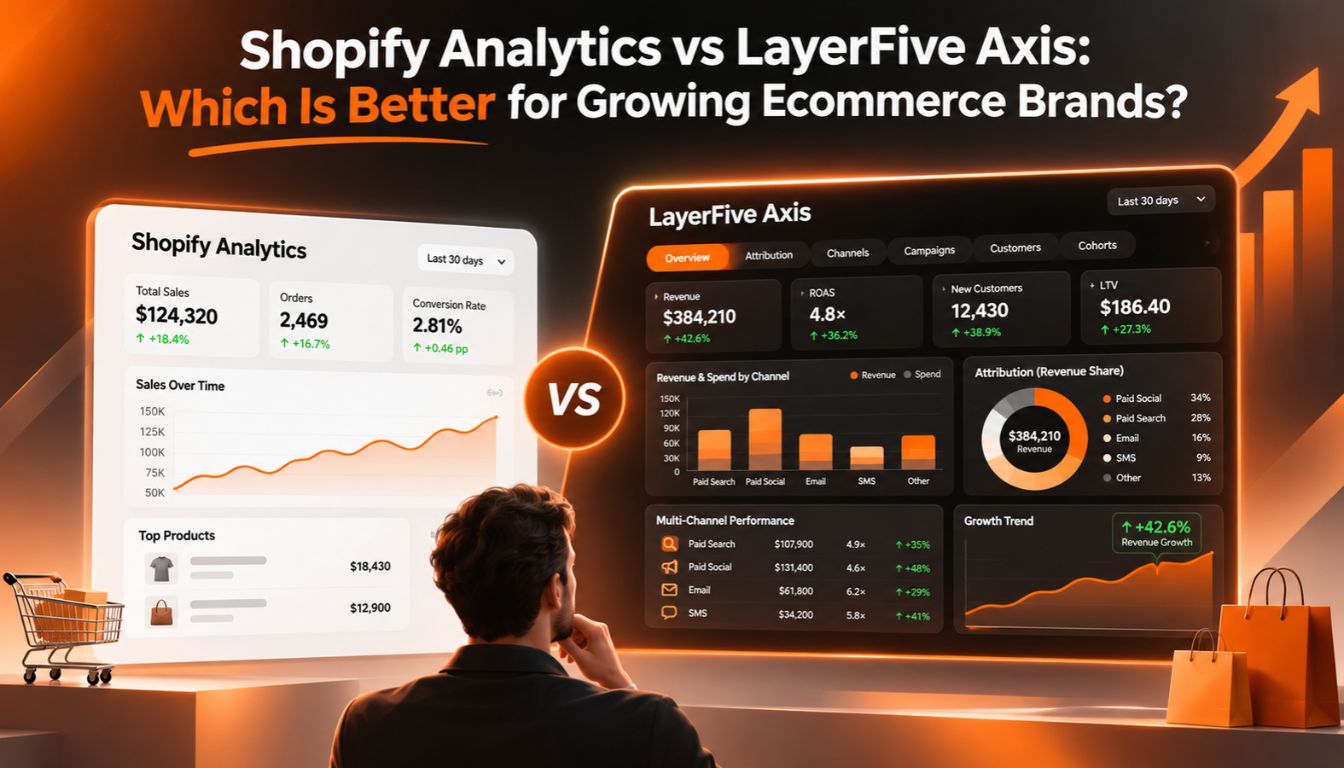
Most tools in this guide combine Shopify, Meta Ads, and Google Ads data, including Triple Whale, Northbeam, Polar Analytics, Supermetrics, and LayerFive Axis. The difference is what each tool does with the gap between ad-platform conversions and Shopify orders in a typical month. A side-by-side view is a dashboard. A tool that explains the gap is analytics. Prioritize the second kind.
Meta Ads and Google Ads each report their own conversions, while Shopify records the orders. When the three totals disagree, a team needs to know which number to trust before it moves budget.
The gap is a data problem before it is an AI problem. Salesforce found the average organization manages data across seven sources. Supermetrics found 50% of marketers wait one to three business days for answers to basic questions, and 73% are dissatisfied with how often they receive data support.
For a Shopify brand, three setup choices decide whether a combined view can be trusted. Treat Shopify orders as the revenue source of truth. Pull Meta Ads and Google Ads spend at campaign level. Add email data from Klaviyo so repeat purchases stay separate from new-customer sales. LayerFive’s guide to a marketing analytics tool for Shopify, Meta, Google Ads, and Klaviyo covers the connection order in detail.
Which tools let marketing teams ask questions about campaign performance in plain English?
Juno, Triple Whale’s Moby, Ask Polar, Supermetrics Agents, Funnel AI, and Improvado’s AI Agent all let marketers ask about campaign performance in plain English, and several also connect to Claude or ChatGPT through MCP. Because plain-English access is now common, the buying question is accuracy: whether the tool answers from reconciled, defined metrics or guesses from raw tables. Test for that first.
Plain-English chat is only the interface. The data underneath decides whether the answer is right. DoubleVerify’s survey found that accuracy and effectiveness of recommendations was the most-cited factor, at 35%, when marketers evaluate AI optimization tools. Data privacy compliance and cost and return on investment followed at 29% each.
Polar Analytics argues that AI tools without a governed semantic layer return confidently wrong numbers. Its example: a tool reports a ROAS of 4.2x, and nobody can tell whether that figure is blended or channel-specific, or whether it includes returns. Kickbite’s guidance on connecting marketing data to AI assistants gives similar advice in plainer terms: fix the data first, ask specific questions, and spot check anything you will quote to someone else.
A fast acceptance test is to ask any tool five questions whose answers you can verify in Shopify and your ad accounts:
- What was new-customer revenue last week?
- Which campaign spent the most in the last seven days?
- What share of last month’s orders came from repeat buyers?
- How did blended ROAS change week over week?
- Which audience had the highest customer acquisition cost over the past 14 days?
If a tool misses the first three, do not trust it with the last two.
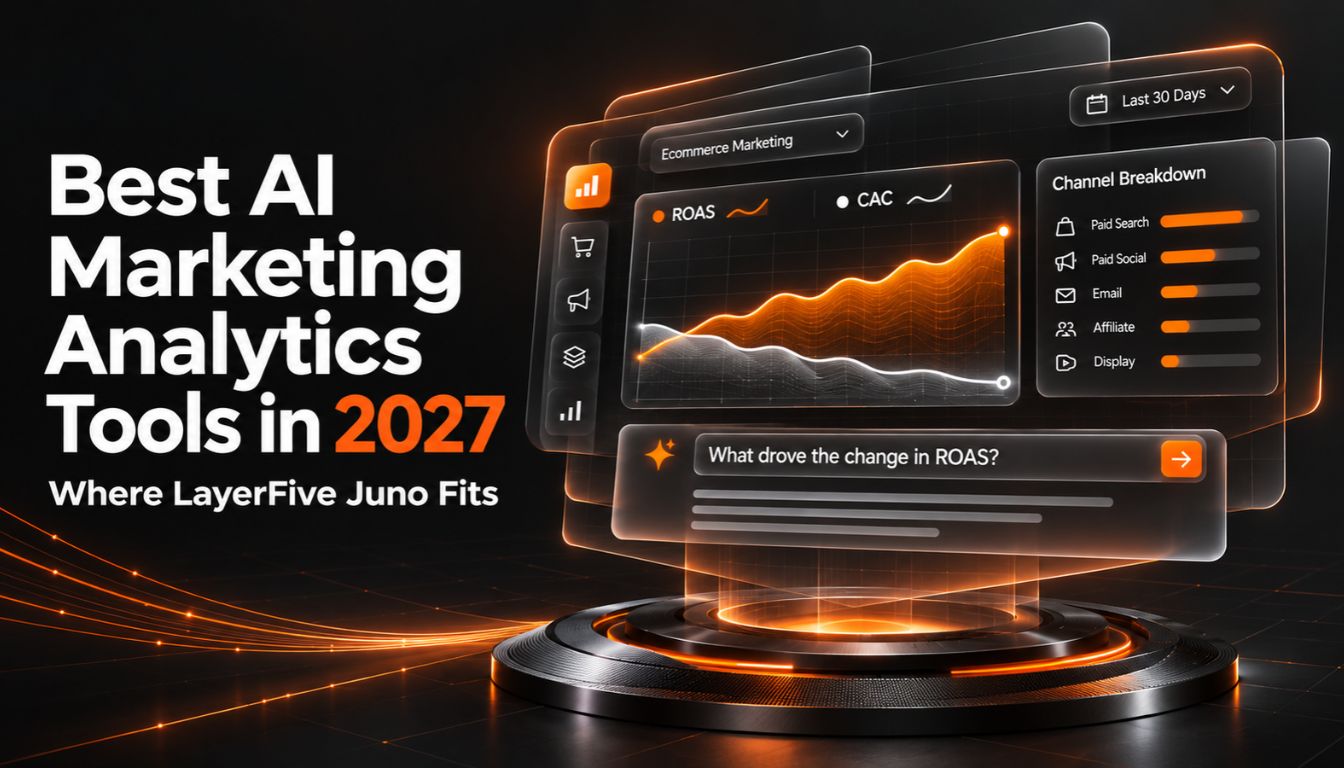
Juno is the part of LayerFive built for this job. It monitors performance, investigates anomalies, and answers questions about marketing data. Teams get the most from it after Axis has connected and reconciled their sources, since a question about ROAS is only as good as the spend and order data behind it. LayerFive’s overview of an AI marketing analytics tool for Shopify stores explains how that setup works.
Can AI marketing analytics tools help explain why ROAS dropped or customer acquisition costs rose?
Yes, when the tool can see store orders, ad spend, and customer history together. AI can narrow a ROAS drop or a customer acquisition cost (CAC) increase to a channel, campaign, audience, or shift in the new versus repeat customer mix. It cannot prove the cause alone. A marketer still confirms the explanation against Shopify and the ad accounts before moving any budget.
Here is a six-step workflow a Shopify team can follow:
- Confirm the drop in Shopify. Compare net revenue, orders, and new-customer count for the same period.
- Split revenue into new-customer and repeat-customer sales.
- Compare spend by channel against the prior period. A shift in spend can mimic a drop in efficiency.
- Compare platform-reported ROAS with first-party attributed revenue. If Meta’s ROAS held steady while store revenue fell, the platform may be over-crediting itself.
- Drill into campaign, audience, and creative, and ask the AI to rank each one’s contribution to the change.
- Decide whether to cut, hold, or test, then verify the decision with a small budget test.
Hypothetical example, with invented numbers for illustration only. A store spends $100,000 in both September and October, split $60,000 on Meta and $40,000 on Google. September revenue is $400,000, from 2,000 new customers at a $125 average first order ($250,000) plus $150,000 of repeat revenue. October revenue is $360,000, from 1,600 new customers ($200,000) plus $160,000 of repeat revenue.
Blended return on ad spend falls from 4.0 to 3.6. New-customer CAC rises from $50 to $62.50, a 25% increase. The $40,000 revenue decline sits entirely in new-customer sales, which fell $50,000, while repeat revenue grew $10,000. That points to acquisition, so the next question is which channel lost new buyers.
Measurement habits make this harder in practice. In a survey of 333 marketing decision-makers fielded April 29 to May 18, 2026, 69% measured email and landing page performance by click-through rate while 41% tracked revenue or pipeline influence. The survey was commissioned by Knak. CaliberMind’s 2026 State of Marketing Attribution Report frames attribution as a decision engine and, in Webtonic’s summary, finds roughly 80% of revenue flows from about 20% of customer journeys, data sources, and tools. A Straight North survey of 101 marketers found 75% consider attribution mission critical or very important, based on self-reported answers.
LayerFive’s best attribution platform for Shopify brands guide shows what to reconcile before shifting spend between Google Ads and Meta.
How should ecommerce teams compare AI analytics tools for reporting, attribution, and performance analysis?
Compare AI analytics tools on six criteria: data coverage, metric definitions, attribution method, traceability of answers, ability to act, and security. Score each tool on questions from your own store, not vendor demo data. Weight attribution method and traceability heaviest, because they decide whether a budget recommendation deserves trust. Reporting speed matters, but only when the numbers underneath are right.
Data coverage means the tool connects Shopify, every paid channel, and email or SMS without manual exports. Check how often data refreshes and how far back it reaches.
Metric definitions decide whether two people get the same answer. Ask how the tool defines ROAS, new-customer CAC, and repeat rate, and whether you can change them.
Attribution method varies. Some tools report ad-platform conversions, some build first-party multi-touch models, and some add media mix modeling or incrementality tests. Each answers a different question, and a tool that blends them should say which one produced a given number. LayerFive’s marketing attribution guide compares the approaches.
Traceability means every answer links back to orders and spend you can inspect. Ability to act separates tools that recommend from tools that change bids or budgets, and that feature should come with approval controls.
Security matters when AI assistants touch customer data. LayerFive reports ISO 27001 and SOC 2 Type 2 certification, according to a May 18, 2026 news summary of its platform launch. Ask every vendor for its current certifications and for how it scopes access to your accounts.
Run the finalists in parallel for 30 days against the same store. Compare their answers with Shopify’s own numbers, and keep the tool whose answers you can reproduce. LayerFive’s list of AI analytics platforms for ecommerce covers the wider category.
How does LayerFive Juno compare with other AI marketing analytics tools for Shopify brands?
LayerFive Juno is built for monitoring performance, investigating anomalies, and asking questions about marketing data, within a stack that also covers unified reporting, first-party attribution, and segments. Triple Whale’s Moby leans toward taking ad actions. Northbeam leans toward attribution modeling. Polar leans toward governed metrics on a warehouse. Choose Juno when you want one connected workflow for Shopify marketing data.
A typical Shopify workflow runs through four LayerFive products in order. Axis connects Shopify, ad platforms, and email data into shared dashboards. Signal adds first-party attribution so channel credit does not rest on ad-platform reports alone. LayerFive reports that Signal identifies two to five times more visitors than the 5% to 15% industry standard, a company claim worth testing in a trial. Edge builds the customer segments a team wants to reach, such as lapsed repeat buyers. Juno then watches performance, flags anomalies, and answers questions such as which channel brought in the new customers behind last week’s revenue change.
The decision at the end is a budget decision. A team sees which channels bring new customers and which only collect credit for sales that would have happened anyway, then moves spend with evidence. For audience work, LayerFive’s guide to first-party data for Shopify explains what to collect before building segments.
LayerFive reports one customer outcome. Billy Footwear grew revenue 36% year over year on 7% additional ad spend after adopting the platform, according to the May 18, 2026 news summary. Treat it as a LayerFive-reported result from a single brand.
Juno fits less well in three situations. A team that wants AI to change bids and launch ads on its own should look at Triple Whale’s Moby 2. A team running media mix modeling and incrementality programs may want Northbeam. A brand that already owns a warehouse and wants governed metrics across finance and marketing may prefer Polar Analytics or a pipeline tool such as Supermetrics.
When is a simpler analytics setup enough?
A simpler setup is enough when spend is modest, one or two channels drive most sales, and one person can reconcile the numbers by hand each week. Shopify reports plus ad-platform dashboards and a weekly spreadsheet can serve a small store. That threshold differs by brand. AI analytics earns its cost once channels multiply and the reconciliation work starts to cost real time.
The signals that a team has outgrown spreadsheets are practical. Reports take hours to assemble. Two people quote different ROAS figures for the same week. Nobody can say how many of last month’s customers were new. Anomalies get noticed days late, after budget has already gone to waste.
Agencies reach that point sooner, because every client multiplies the reporting work. Supermetrics’ survey found only 33% of marketers can activate their data effectively and 41% feel confident analyzing it, which suggests many teams lack the capacity to build this themselves.
How can you evaluate LayerFive Juno on your own data?
Start with a short trial on your own store. Connect Shopify, Meta Ads, Google Ads, and email, run the five-question acceptance test above, and compare Juno’s answers with Shopify’s numbers. If the answers match and the explanations point to a decision you can act on, expand to attribution and segments. Judge it on your own store, not a sample. Book a demo to see it with your data.
To see how the pieces fit before booking, explore LayerFive Juno or book a LayerFive demo.
Frequently asked questions
What is an AI marketing analytics tool?
An AI marketing analytics tool connects store, advertising, and customer data, then uses machine learning or language models to report results, explain changes, and flag problems. Many also answer questions in plain English. Some can act on findings, such as pausing an ad or moving budget. The useful ones trace every answer back to the underlying orders and spend, so a marketer can check the number before acting.
What are the best AI marketing analytics tools for Shopify brands?
No single tool wins every job. Triple Whale suits teams that want AI to take supported actions. Northbeam suits attribution-heavy programs. Polar Analytics suits teams that need governed metrics. Supermetrics, Improvado, and Funnel suit agencies pulling many sources. LayerFive suits Shopify brands that want unified reporting, first-party attribution, segments, and a Juno layer for monitoring in one stack. Match the tool to your biggest reporting gap.
Can AI marketing analytics tools use first-party customer data to analyze new and repeat buyers?
Yes, if the tool receives customer-level order data and can match purchases to one customer record. Shopify order history marks first and repeat purchases, and email data from Klaviyo adds retention context. Tools with first-party tracking, such as LayerFive Signal, can also connect ad touchpoints to those buyers. Without customer matching, most tools report orders and cannot reliably separate acquisition from repeat revenue.
What data should an ecommerce team connect before using AI to guide marketing budget decisions?
Connect Shopify orders and customers first, then spend and campaign data from Meta Ads and Google Ads. Add email and SMS data from a tool like Klaviyo, plus product cost or margin data if you plan to optimize for profit. Agree on definitions for ROAS, new-customer CAC, and repeat rate before turning on AI, because the AI will repeat whatever definitions it finds.
How is AI marketing analytics different from GA4 or Shopify Analytics?
Shopify Analytics reports store activity, and GA4 reports site behavior, but neither is designed mainly to reconcile ad spend, ad-platform conversions, and customer history in one view. AI marketing analytics tools add that cross-channel layer, then answer questions and flag changes on top of it. Many teams keep GA4 and Shopify reports as a cross-check and use the AI tool for budget decisions each week.
Do AI marketing analytics tools replace analysts?
No. They shorten the path to an answer, but an analyst still defines the metrics, checks the numbers, and decides what to do. A tool also cannot know about an unlogged promotion. Supermetrics’ 2026 survey found 50% of marketers wait one to three business days for answers to basic questions, which is where AI helps most. Strategy, test design, and judging a surprising result stay with people.
How accurate are plain-English answers from AI analytics tools?
Accuracy depends on the data and metric definitions underneath the chat box. DoubleVerify’s 2026 survey of 2,020 marketers found accuracy and effectiveness of recommendations was the most-cited factor, at 35%, when evaluating AI optimization tools. Test any tool with five questions you can verify in Shopify, and spot check every number before sharing it with a client or executive. Confident wording is not proof of accuracy.
What does LayerFive Juno do?
Juno is the LayerFive product for monitoring marketing performance, investigating anomalies, and asking questions about marketing data. It sits alongside Axis for unified reporting, Signal for first-party attribution, and Edge for customer segments. It is aimed at Shopify and DTC teams that need to move from noticing a change to finding its cause, then deciding on budget. Book a demo to see it on your own data.
Which AI marketing analytics tools suit ecommerce agencies?
Agencies need multi-client reporting, consistent definitions, and fast onboarding. Supermetrics, Improvado, and Funnel focus on pulling many sources into reports and AI assistants. Polar Analytics and Triple Whale serve brands that want a single commerce view. LayerFive’s Axis targets unified dashboards and reporting for marketing teams, including client-ready views. Ask each vendor how client workspaces, permissions, and report exports work before you commit.
Is it safe to connect marketing data to an AI assistant?
It can be, with care. Kickbite’s August 25, 2026 guidance on MCP advises fixing the data first, scoping each connection with OAuth instead of static keys, asking specific questions, and spot checking anything you will quote to someone else. Also check the vendor’s security certifications, such as ISO 27001 and SOC 2 Type 2, and limit access to only the accounts the assistant needs.
Sources
All sources were reviewed on November 18, 2026. Figures are self-reported survey results unless noted.
- Supermetrics, 2026 Marketing Data Report: https://supermetrics.com/blog/marketing-data-report-2026
- Supermetrics press release, February 24, 2026: https://www.bolsamania.com/nota-de-prensa/mercados/only-6-of-marketers-have-fully-implemented-ai-according-to-new-supermetrics-report–21804660.html
- Salesforce, State of Marketing, 10th edition: https://www.salesforce.com/au/blog/?p=69233
- Jasper, State of AI in Marketing 2026, January 28, 2026: https://www.jasper.ai/blog/state-of-ai-marketing-2026
- DoubleVerify 2026 Global Insights Report, via Advanced Television, November 9, 2026: https://www.advanced-television.com/?p=295521
- Knak survey, via MarTech, fielded April 29 to May 18, 2026: https://martech.org/ai-speeds-marketing-production-but-measurement-lags/
- CaliberMind, 2026 State of Marketing Attribution Report, April 2, 2026: https://calibermind.com/2026-state-of-attribution-report/
- Webtonic, attribution statistics summary: https://www.webtonic.io/blog/attribution-marketing-statistics
- Straight North, 2026 Marketing Attribution Survey: https://www.straightnorth.com/blog/marketing-attribution-challenges-in-2026-how-marketers-are-adapting-to-incomplete-data/
- Triple Whale knowledge base, Moby 2: https://kb.triplewhale.com/en/articles/15180582-moby-2
- ecommerceFastlane, Northbeam review, April 14, 2026: https://ecommercefastlane.com/northbeam-review/
- TrueProfit, AI analytics platforms for Shopify, updated August 24, 2026: https://trueprofit.io/blog/ai-analytics-platforms-for-shopify
- Polar Analytics, best analytics tool for Shopify stores: https://www.polaranalytics.com/post/best-analytics-tool-for-shopify
- Coupler.io, best AI agents for multichannel marketing analytics, November 9, 2026: https://blog.coupler.io/?p=86634
- Kickbite, marketing data MCP guidance, August 25, 2026: https://www.kickbite.io/en/blog/marketing-data-mcp-claude-chatgpt
- LayerFive on the Shopify App Store: https://apps.shopify.com/layerfive-consumer-management
- Pulse, LayerFive platform launch summary, May 18, 2026: https://www.pulse.bot/digital-marketing/news/layerfive-unveils-ai-native-marketing-intelligence-platform-to-cut-ad-waste-46ad7051-61d4-47d4-9d1a-afcca9cd5981/