
Quick answer
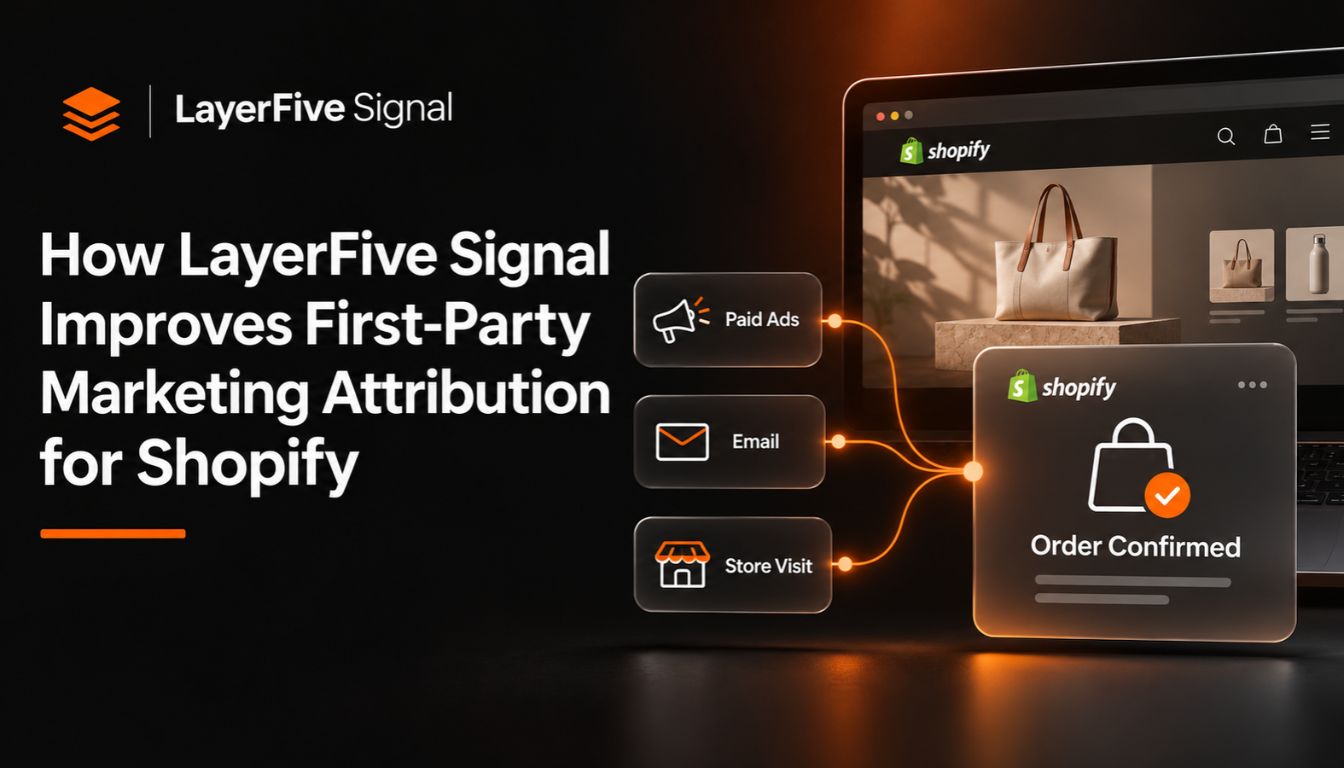
First-party marketing attribution for Shopify connects ad clicks, site visits, and Shopify orders using data your own store collects, so channel credit reflects real customer journeys instead of each ad platform’s self-reported numbers. LayerFive Signal does this with the L5 Pixel, identity resolution, and multi-touch attribution reconciled against Shopify orders. It works best beside Shopify Analytics and GA4, which stay useful for order totals and on-site behavior.
TL;DR
- Shopify, GA4, and Meta Ads disagree because each counts different events with different click rules, windows, and identity. Meta stopped returning 7-day and 28-day view-through windows in its Ads Insights API on January 12, 2026. GA4 now accepts custom lookback windows from 1 to 90 days for click-through conversions.
- First-party attribution joins ad clicks, visits, and orders on identifiers your store controls, so you can audit the result against Shopify orders.
- Multi-touch attribution splits credit across the touchpoints in a journey. Shopify’s own reports offer five rules-based models, all click-based.
- LayerFive Signal pairs the L5 Pixel with identity resolution. LayerFive reports that it identifies 2 to 5 times more visitors than the 5 to 15 percent industry standard. Treat that as a vendor figure and test it on your traffic.
- Use Shopify orders as the revenue anchor, GA4 for behavior, and Signal for journey credit.
- Move budget in steps and confirm large shifts with holdout or incrementality tests.
What is first-party marketing attribution for Shopify?
First-party marketing attribution for Shopify measures which channels contribute to orders using data your store collects directly: pixel events, UTM parameters, checkout data, and customer records. It links each order back to the clicks and visits that came before it. The goal is a view of channel contribution you can audit against Shopify orders, instead of relying only on conversions that ad platforms report about themselves.
First-party customer data is information your business collects from shoppers on properties you own. That includes storefront events, UTM-tagged landings, order records in Shopify, and email or SMS engagement. Because you collect it, you can check it. A conversion count computed inside an ad network offers no such check.
A touchpoint is any recorded interaction before a purchase, such as an ad click, a site visit, or an email click. Customer journey mapping puts those touchpoints in order for each buyer. Attribution then assigns credit for the order to those touchpoints under a stated rule.
Confidence in measurement is low across the industry. The IAB’s State of Data 2026 report surveyed more than 400 senior US buy-side decision makers with BWG Global. MediaPost’s coverage says incrementality tests, attribution, and marketing mix models are now standard tools, yet up to 75 percent of marketers say they fall short on rigor, speed, trust, or efficiency. A compiled review of the report lists 73 percent using attribution analysis and 76 percent using incrementality tests (n=430, February 2026). Only 39 percent use all three together.
Journeys also pick up new touchpoints. Shopify reported that AI-referred orders on its platform grew nearly 13 times year over year in Q1 2026, and that AI-referred sessions beginning on a product page converted 49 percent higher than organic search (Shopify Enterprise, May 11, 2026). Shopify adds that Google AI Overviews referrals are classified as organic, so standard reports likely undercount AI-mediated sales. A store that watches only last-click channel totals cannot see where those shoppers first met the brand.
Why do Shopify, GA4, and Meta Ads report different conversion numbers?
They report different numbers because each system counts different events under different rules. Shopify credits clicks to the orders it recorded. GA4 applies its own attribution model and lookback window to key events. Meta counts conversions inside its own window and can include a one-day view. The same order can be claimed by all three, or by none, depending on the settings you compare.
Shopify’s marketing reports support five models: last non-direct click, last click, first click, any click, and linear. The Shopify Help Center describes click-based credit and does not mention view-through, so a channel earns credit only when a shopper clicked it. The same page names last non-direct click as the default for marketing activity data, while reports that pair a sales metric with a marketing dimension select last click. Two Shopify screens can therefore disagree before any other tool enters the picture.
Meta defaults to a 7-day click and 1-day view window. On January 12, 2026, Meta’s Ads Insights API stopped returning the 7-day view and 28-day view windows. The 1-day click, 7-day click, 28-day click, 1-day engaged view, and 1-day view windows remain, according to PPC Land’s report on the change. If you compare a Meta export from before that date with one after it, the drop may come from the reporting change and not from weaker ads.
GA4 uses data-driven attribution by default, according to Google Analytics Help. On August 11, 2026, Google Analytics replaced fixed lookback windows with editable ones: 1 to 90 days for click-through conversions and 1 to 30 days for engaged-view conversions, as PPC Land reported. The release note does not say whether the change applies retroactively. Two analysts in the same property can produce different totals if one edits a window.
None of these tools is wrong. Each answers a different question under its own rules. Fixing the gap starts with one stable record of what happened: the Shopify order, plus the ordered touchpoints before it. LayerFive’s comparison of Shopify Analytics, Google Analytics, and LayerFive walks through the same disagreement from the reporting side.
How can first-party data connect ad clicks, website visits, and Shopify orders?
First-party data connects them through a shared identifier. A pixel records the click parameters and the visit, identity resolution ties separate sessions to one visitor, and the Shopify order, which carries an email or customer ID, closes the loop. Each order then arrives with the ordered touchpoints that preceded it, so you can inspect credit instead of accepting a platform’s claim.
In practice the chain has four links:
- Capture. UTM parameters and ad click identifiers are stored when a shopper lands, along with page views, add-to-cart, and checkout steps. Reliable capture starts with the practices in LayerFive’s guide to first-party data collection on Shopify.
- Resolve identity. Customer identity resolution decides whether a phone session on Monday and a laptop session on Thursday belong to the same person. Deterministic matching uses exact identifiers such as a logged-in email. Probabilistic matching infers a match from device and network signals and carries a confidence level.
- Join to the order. When the shopper checks out, the order’s email, phone, or customer ID is matched to the resolved profile, and earlier sessions attach to that order.
- Apply a credit rule. A model distributes credit across the touchpoints. The rule is visible, so a buyer can see why a channel got what it got.
Without step 2, every session looks like a different person and the chain breaks. LayerFive’s explainer on identity resolution covers the matching methods and their trade-offs in more detail. Cross-channel conversion tracking only works as well as that stitching.
How does multi-touch attribution account for more of the Shopify customer journey than last-click attribution?
Last-click attribution gives 100 percent of the credit to one touchpoint, usually the final click. Multi-touch attribution spreads credit across the touchpoints in a journey, so an early Meta video and a later branded search each receive a share. That shows which channels start demand and which close it. It only works when identity resolution stitches sessions into one journey.
Shopify’s reports show the limits of single-touch views. Last click and last non-direct click reward channels that show up late, such as branded search, email, and SMS reminders. First click favors discovery channels. Any click credits every clicked channel, so attributed totals can exceed order totals. Linear splits credit evenly. All five are rules-based and click-based, which makes them useful for a first look and incomplete for a full journey.
Multi-touch models add weighting options. Linear, time-decay, and position-based models distribute credit differently, as Klaviyo’s overview explains. Position-based rewards the first and last touches most. Time-decay gives later touches more weight. Which one fits depends on the question: first-touch views answer where new customers come from, while time-decay views answer what closes the sale.
Multi-touch credit is still an estimate of contribution. It does not prove that removing a channel would remove its orders. That is why measurement teams pair it with experiments: in the IAB data above, 76 percent of buy-side leaders use incrementality tests. For a deeper look at models on Shopify, see LayerFive’s guide to multi-touch attribution for Shopify.
How does LayerFive Signal help Shopify brands measure which marketing channels contribute to sales?
LayerFive Signal collects first-party events with the L5 Pixel, resolves visitors across sessions and devices with deterministic and probabilistic matching, and applies multi-touch attribution reconciled to Shopify orders. The team sees the ordered touchpoints and channel credit for each order, then compares channels by contribution. LayerFive reports that Signal identifies 2 to 5 times more visitors than the 5 to 15 percent industry standard.
The workflow starts with data a Shopify brand already has: the storefront, ad accounts in Meta and Google, an email platform such as Klaviyo, and order history in Shopify. The Shopify App Store listing names Facebook, Google, Gorgias, Klaviyo, TikTok, and Yotpo as integrations, and describes the Signal plan as covering marketing attribution and insights, funnel insights, and identifying more abandoned shoppers.
What the team sees is a journey for each order instead of a single channel label. A marketer can open a purchase and read, in order, the Meta prospecting click, the organic visit, the email click, and the branded search that came before it. Channel reports then roll those journeys up, so credit totals tie back to real orders. The decision that follows is concrete: whether Meta prospecting is feeding branded search, and whether the next dollar belongs there or in Google.
An independent review published September 3, 2026 by Influencers Time describes Signal as an identity layer running two matching methods in one pass. It also raises fair cautions. The 2 to 5 times figure comes from LayerFive’s own case-study benchmarking, and the multiple depends on traffic mix and the starting match rate. A fivefold lift on a 4 percent baseline reaches only about 20 percent. Probabilistic matches are estimates, and buyers should ask how consent and opt-outs are handled. The reviewer recommends a 30 to 60 day pilot on live traffic.
LayerFive also reports a customer result. Billy Footwear achieved 36 percent revenue growth on 7 percent additional ad spend. This is a LayerFive-reported outcome, so read it as a case study and not as a benchmark for your store.
How can Shopify brands use LayerFive Signal alongside Shopify Analytics and GA4?
Run Signal beside both tools and give each a job. Shopify Analytics is the record of orders and sales. GA4 is strongest for on-site behavior and Google ecosystem reporting. Meta Ads Manager is where you buy and tune delivery. Signal sits between them and explains the gaps by showing each order’s journey and the credit each channel earned across every ad platform.
Think of the stack in layers. Shopify holds revenue truth, so every other number should reconcile to it. GA4 shows what visitors did on the site and how Google channels perform under Google’s rules. Platform dashboards show delivery, spend, and creative results. Signal adds the cross-channel layer none of them provides: one identity per shopper and one credit rule across channels.
Two neighboring steps matter. If your main problem is dashboards that disagree or manual reporting across ad accounts, start with LayerFive Axis, the unified reporting product, and add Signal when channel credit is the open question. LayerFive’s comparison of GA4 and Axis explains where that line falls. Once you trust the journeys, LayerFive Edge can turn them into predictive audiences for activation.
Another approach may be enough in some cases. A store with one paid channel, modest spend, and disciplined UTMs can often manage with Shopify’s marketing reports and GA4. Signal earns its place when several paid channels overlap, journeys span multiple sessions, and the budget at stake is large enough that a wrong call is expensive.
What should a team reconcile before shifting spend between Google Ads and Meta?
Reconcile three things first: the time window, the order set, and the overlap between channels. Align Meta and GA4 settings to the same click window, count only valid Shopify orders, and measure how many orders both platforms claim. Only then compare cost per order across Google Ads and Meta over the same 30-day period. Skipping this turns a reporting difference into a budget decision.
Here is a worked example. These numbers are hypothetical and exist only to show the arithmetic. A store spent $60,000 on Meta and $50,000 on Google Ads over 30 days and recorded 2,000 valid Shopify orders.
- Read the platform claims. Meta reports 700 purchases and Google reports 650. Added together, that is 1,350 orders, or 67.5 percent of all store orders, before email, organic, and direct are counted.
- Measure the overlap. Journeys from the first-party record show that 560 orders touched both Meta and Google before purchase. Unique paid-claimed orders are 700 + 650 − 560 = 790, or 39.5 percent of orders.
- Reassign credit. Under a linear rule, each overlapping order splits 50/50. Meta earns 140 + 280 = 420 orders. Google earns 90 + 280 = 370 orders.
- Compare cost per order. Platform-reported cost per order is about $85.71 for Meta and $76.92 for Google, so Meta looks 11.4 percent more expensive. Under linear credit it is $142.86 for Meta and $135.14 for Google, a gap of 5.7 percent.
The reading: both platforms over-claim, Google still looks cheaper, and the gap is much smaller than the dashboards suggest. That is not a case for a large reallocation. It is a case for a controlled test. Raise the better channel’s budget by a modest step, hold a comparison group, and watch new-customer orders and margin.
Check these metrics before and after any shift: valid orders reconciled to Shopify, new versus returning customers, days from first touch to order, overlap rate between channels, and contribution margin after ad spend. LayerFive’s piece on the Shopify attribution gap discusses why identity coverage drives how much of this you can see.
What data does a Shopify store need to set up first-party attribution?
A Shopify store needs six things: admin access with order history, connected Meta and Google ad accounts, consistent UTM tagging, a first-party pixel on the storefront, customer identifiers such as email, and consent settings. Add your email platform so email touches join the journey. Put consent settings in place before collection starts, so capture follows each shopper’s regional rules and your privacy policy matches what you collect.
Walk through the list before any vendor demo:
- Shopify access and order history. Orders are the anchor for every reconciliation. Cancelled and test orders should be excluded.
- Ad accounts. Meta and Google cost and click data supply spend and the campaign context.
- UTM discipline. Every paid, email, SMS, and influencer link needs a consistent source, medium, and campaign. Untagged links fall into direct or unassigned and distort every model.
- A first-party pixel. It records page views, add-to-cart, and checkout events under your own domain context.
- Customer identifiers. Email or phone captured at checkout, newsletter signup, or login gives identity resolution something exact to match on.
- Consent and privacy settings. Document what you collect and how opt-outs are honored.
How can Shopify brands use first-party attribution to decide where to increase or reduce ad spend?
Use first-party attribution to rank channels by their contribution to orders, then test before you move money. Increase spend where reconciled credit and margin hold up, and reduce it where platform-reported results disappear after overlap is removed. Treat attribution as directional evidence and confirm large changes with a holdout test, because credit rules only estimate contribution and do not prove cause.
A simple decision loop works well for a growth team:
- Reconcile each channel’s claimed orders to Shopify orders and remove overlap.
- Review credit under at least two models, such as first-touch and time-decay, to see which channels start and which close demand.
- Check new-customer share, days to convert, and margin by channel.
- Change budget in a modest step on the channel with the strongest case.
- Hold a comparison group or run a geo or audience holdout, and read the result after one full buying cycle.
Over-reliance on one view is the common failure. Reducing a channel because last click gave it little credit can starve the touchpoints that create demand. Raising a channel because its own dashboard looks good can fund a platform that is claiming orders another channel earned. The supply of imperfect signals is the reason to compare several. LayerFive’s guide to optimizing ad spend with attribution software goes deeper on the budgeting step.
Measurement fragmentation raises the stakes. In StackAdapt’s State of Programmatic Advertising 2027 report, a survey of 885 senior marketers fielded in July 2026, only 7 percent said they have a fully unified measurement strategy (PPC Land summary). It is a vendor-run survey with a programmatic focus, so read it as a signal of how common the problem is and not as a Shopify benchmark.
What are the limits of first-party attribution?
First-party attribution cannot prove cause, cannot see untracked touchpoints, and depends on how much of your traffic can be identified. Consent choices reduce capture, probabilistic matches are estimates, and offline or word-of-mouth influence stays invisible unless you ask customers directly, for example in a post-purchase survey. Use it to rank channels and shape tests, then confirm large decisions with experiments and margin data.
Three limits deserve plain statements. First, coverage varies. If only a small share of visitors can be identified, the journeys you see are partial, and a vendor’s headline multiple means little without your starting rate. Second, privacy rules apply. Collection must respect consent, and any matching method that infers identity should be reviewed with your privacy counsel. Third, no model settles the argument. Compare models and test.
A fair evaluation asks any vendor, including LayerFive, five questions: how much of my traffic is identified, how matches are scored, how credit totals reconcile to Shopify orders, how consent is honored, and whether the data can be exported to your other tools.
Next step
If conflicting numbers are slowing your budget decisions, start with a pilot. Explore LayerFive Signal to see the product, or book a demo and bring a recent Meta export, a GA4 report, and your Shopify order totals so the reconciliation can run on your own data. Run the pilot for 30 to 60 days, segment results by source, and compare order totals with Shopify before you change spend.
Frequently asked questions
What is the difference between first-party attribution and platform-reported attribution?
First-party attribution uses events your store collects and ties them to Shopify orders, while platform-reported attribution is the conversion count each ad network computes inside its own system. Platforms apply their own windows, such as Meta’s 7-day click and 1-day view default, and cannot see other channels. First-party attribution lets you compare channels under one rule and check totals against actual orders.
Does LayerFive Signal replace Shopify Analytics or GA4?
No. Shopify Analytics remains the record of orders and sales, and GA4 remains useful for on-site behavior and Google ecosystem reporting. LayerFive Signal adds identity resolution and multi-touch attribution across channels, then reconciles credit against Shopify orders. Run it beside both tools to explain the gaps between them, and use Shopify order totals as the check on every number.
How does LayerFive Signal identify returning visitors?
Signal collects first-party events with the L5 Pixel and applies deterministic matching, such as email or hashed phone number, plus probabilistic matching that infers identity from device and network signals. LayerFive reports it identifies 2 to 5 times more visitors than the 5 to 15 percent industry standard. That multiple depends on your starting match rate and traffic mix, so test it on your own traffic.
How do I connect ad clicks to Shopify orders?
Tag every ad link with consistent UTM parameters, capture clicks and visits with a first-party pixel, and pass the visitor’s identifier through to checkout so the Shopify order can be matched to earlier sessions. Identity resolution then joins sessions from the same person. Shopify’s own marketing reports rely on traffic it can tie to marketing activity such as UTM campaigns, so untagged links drop out of channel totals.
Why does Meta report more purchases than Shopify?
Meta counts a purchase when someone clicked within seven days or viewed the ad within one day, and it counts conversions inside its own system only. Shopify records each order once. If the same buyer also clicked a Google ad, both platforms can claim the order, so platform totals can add up to more than your actual orders. Compare them using matching windows.
Is multi-touch attribution better than last-click for every Shopify store?
No. A store that runs one paid channel and sells low-consideration products may learn little from multi-touch credit. Multi-touch helps when shoppers see several channels before buying, because it shows which channels start journeys and which finish them. It still estimates contribution, so confirm big budget moves with holdout or incrementality tests before you commit.
What data does a Shopify store need before setup?
You need admin access to Shopify, connected ad accounts for Meta and Google, consistent UTM tagging, a first-party pixel installed on the storefront, and order history. Add your email platform, such as Klaviyo, so email touches join the journey. Consent settings should be in place so collection follows the rules that apply to each shopper’s region.
How long should a Shopify brand test an attribution tool before moving budget?
An independent review of LayerFive Signal recommends a 30 to 60 day pilot on live traffic, segmented by source, with downstream conversion checked and not only match volume. Use a window long enough to cover your typical time from first visit to purchase, then compare the tool’s order totals with Shopify before changing spend.
Can first-party attribution measure AI search referrals?
Partly. Shopify reported that AI-referred orders grew nearly 13 times year over year in Q1 2026, but Google AI Overviews referrals are classified as organic. Any attribution tool can credit AI assistants only when the referrer or UTM identifies them. Ask a vendor how it classifies those sources before relying on its AI channel numbers.
Which LayerFive products work with Signal?
Axis unifies marketing and ad data into reporting, Signal handles first-party identity resolution and attribution, Edge builds predictive audiences for activation, and Juno supports monitoring and questions about your marketing data. Start with Signal when channel credit is the problem. Start with Axis when dashboards disagree or reporting is manual, then add Signal.
Sources
- IAB, State of Data 2026 (February 2026): https://www.iab.com/state-of-data
- MediaPost, AI Wants To Fix Media Measurement (IAB State of Data 2026 coverage): https://www.mediapost.com/research/1285/ai-wants-to-fix-media-measurement-advertisers-cautiously-optimistic/
- Digital Applied, Marketing Attribution Statistics 2026 (compiled review, November 2026): https://www.digitalapplied.com/blog/marketing-attribution-statistics-2026-sourced
- Shopify Enterprise, AI search insights (May 11, 2026): https://www.shopify.com/enterprise/blog/ai-search-insights
- Shopify Help Center, Marketing reports: https://help.shopify.com/manual/reports-and-analytics/shopify-reports/report-types/marketing-reports
- PPC Land, Meta restricts attribution windows in Ads Insights API (effective January 12, 2026): https://ppc.land/meta-restricts-attribution-windows-and-data-retention-in-ads-insights-api/
- Google Analytics Help, How to attribute credit for key events: https://support.google.com/analytics/answer/12958241?hl=en
- PPC Land, Google Analytics drops the fixed 3-day engaged-view window (August 2026): https://ppc.land/google-analytics-drops-the-fixed-3-day-engaged-view-conversion-window/
- Klaviyo, What is multi-touch attribution: https://www.klaviyo.com/solutions/analytics/what-is-multi-touch-attribution
- Shopify App Store, LayerFive Audience & Analytics: https://apps.shopify.com/layerfive-consumer-management
- Influencers Time, LayerFive Signal 2-5x Match Rate Claim (September 3, 2026): https://www.influencers-time.com/layerfive-signal-2-5x-match-rate-claim-verified-or-hype/
- PPC Land, StackAdapt survey (State of Programmatic Advertising 2027, October 2026): https://ppc.land/stackadapt-survey-42-say-silos-waste-over-a-fifth-of-programmatic-budget/