Quick answer: AI analytics platforms for ecommerce unify store, ad, and customer data, then use machine learning to predict customer value, score audiences, assign revenue credit across channels, and flag problems before they cost money. The best platforms fix the data layer first and add prediction second. LayerFive is built in that order: Axis unifies reporting, Signal resolves identities, Edge builds predictive audiences, and Juno adds agentic AI.
TL;DR
- Ecommerce keeps growing. The US Census Bureau reports Q2 2026 retail ecommerce sales of $340.2 billion, up 12.2% year over year.
- Measurement is the weak spot. IAB’s State of Data 2026 found that 75% of buy-side marketers say attribution, incrementality, and marketing mix models fall short.
- Bad data limits AI. Salesforce’s 2026 State of Marketing report found that 98% of marketers using AI hit at least one data barrier to personalization.
- Budgets are flat. Gartner’s 2026 CMO Spend Survey puts marketing at 7.8% of revenue, with 15.3% of that going to AI.
- A strong platform unifies data, resolves identity, predicts customer value, and recommends action.
- Choose on data foundations, attribution transparency, activation, security, and cost, in that order.
- LayerFive combines Axis, Signal, Edge, and Juno in one stack for Shopify brands, agencies, and SaaS teams.
What are AI analytics platforms for ecommerce?
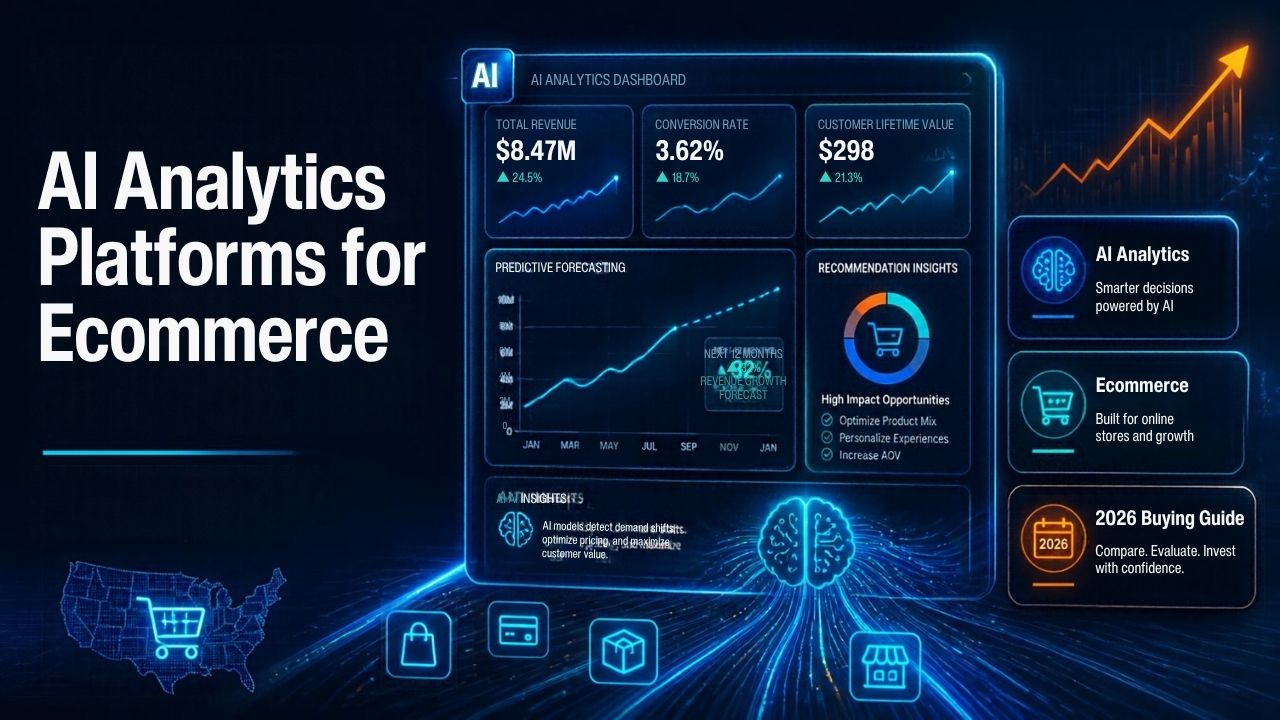
An AI analytics platform for ecommerce is software that collects data from your store, ad accounts, email tools, and website activity, then applies machine learning to explain results and predict outcomes. It goes beyond reporting. It estimates customer lifetime value, scores shoppers by purchase intent, assigns revenue credit across channels, and recommends where the next ad dollar should go and why.
Five terms come up in every vendor demo, so here are plain definitions. Predictive analytics for ecommerce uses past orders and behavior to forecast future purchases. Customer lifetime value (CLV) prediction estimates how much a shopper will spend across the whole relationship. AI-driven customer segmentation groups shoppers by behavior and predicted value instead of fixed rules. Customer behavior analytics tracks what visitors do before and after they buy. Marketing attribution analytics assigns revenue credit to the ads and channels that influenced each order.
For a longer primer, read LayerFive’s guide to what an AI analytics platform is and how it works.
How AI analytics differs from ecommerce analytics software
Traditional ecommerce analytics software reports what happened: sessions, orders, revenue, and conversion rate. An AI analytics platform adds a prediction and action layer. It forecasts which customers will buy again, which campaigns are losing efficiency, and which audiences deserve budget. The difference matters because a dashboard still needs a person to notice a problem, while an AI layer can surface it, rank it, and trigger a response.
Shopify’s built-in reports and GA4 both serve a purpose, and most stores start there. The limits show up when a brand runs Meta, Google, TikTok, and email at the same time. Each tool reports its own version of a conversion, and nobody reconciles them. An ecommerce data analytics platform does the reconciling, and the AI layer then works from reconciled numbers. LayerFive’s comparison of LayerFive and Google Analytics shows where that gap appears in practice.
Why ecommerce brands need AI analytics in 2026
Online sales are growing faster than total retail, and the channels that produce them keep multiplying. The US Census Bureau put Q2 2026 retail ecommerce at $340.2 billion, up 12.2% year over year, and AI search is becoming a real traffic source. More channels and more buying paths mean more places for budget to leak, which is where AI analytics earns its cost.
According to the Census Bureau’s quarterly data, ecommerce reached 17.1% of total US retail sales in Q2 2026, up from 16.3% a year earlier, while total retail grew 6.7%. eMarketer’s US ecommerce forecast expects online sales to grow 7.9% in 2026 and projects that AI-driven sales will rise from 3.2% of US retail ecommerce in 2026 to 15.8% by 2030 in its base case. Shoppers increasingly start in an assistant instead of a search box, which changes where brands need to measure.
Budgets are not keeping pace. Gartner’s 2026 CMO Spend Survey, fielded from January through March 2026 among 401 marketing leaders, found marketing budgets at 7.8% of company revenue, up from 7.7% in 2025. Some 56% of CMOs say they lack the budget to deliver their 2026 strategy. CMOs direct an average of 15.3% of marketing budgets to AI, yet only 30% describe their AI readiness as mature. Gartner’s June 2026 release adds that awareness and conversion now take 62.6% of total media spend, so most of the money sits in the channels that attribution has to judge.
Flat budgets, rising AI spend, and more places to advertise leave little room for wasted media. That is the practical case for an AI analytics platform: it finds the waste, and it finds the customers worth more than they look.
The AI traffic shift is already in the numbers
Shopify said on its Q1 2026 earnings call that AI-driven traffic to Shopify stores grew eightfold year over year, while orders from AI-powered searches rose nearly thirteenfold. Shopify also said first-time buyers arrive from AI searches at nearly twice the rate they arrive from traditional organic search. Brands that cannot separate this traffic from everything else are making budget decisions with part of the picture missing.
Shopify’s president also said that traffic from catalog-powered AI searches converts at twice the rate of general AI searches that rely on scraped or outdated data, as Digital Commerce 360 reported. The practical point is that AI referrals need their own line in your reports. They also need identity resolution behind them, so a shopper who researches in an assistant and buys days later stays connected to the original visit. LayerFive’s first-party attribution guide for Shopify covers the setup.
The measurement problem: why attribution still disappoints
IAB’s State of Data 2026 report, produced with BWG Global, found that 75% of buy-side marketers say their attribution, incrementality testing, and marketing mix models fall short. The causes include signal loss, privacy rules, and fragmented data. About half of respondents already scale AI inside measurement, and IAB estimates AI could free up $26.3 billion in media investment value by making measurement faster and more adaptive.
Forrester’s Predictions 2026 for B2C marketing points the same way. It expects marketers’ confidence in measuring business impact to fall by 7% in 2026, and it reports that 64% of US B2C marketing executives expect 2026 to be more volatile than 2025. Forrester links the confidence drop to growing concern about data transparency as AI becomes part of measurement.
The honest read is that AI does not repair a broken signal. It speeds up whatever the signal says, including the errors. Each ad platform counts conversions inside its own walls and credits itself, which is why ad platforms can mislead you even when nobody is lying. An independent attribution layer built on first-party data gives you a second opinion to compare against.
Fragmented data caps what AI can do
Salesforce’s State of Marketing 2026 report, based on responses from nearly 4,500 marketers, found that 98% of marketers using AI report at least one data-related barrier to personalization, such as silos, poor quality, or sheer volume. The same report found that 84% of marketers admit to running generic campaigns. AI tools work on the data they receive, so disconnected systems produce average results at higher speed.
Salesforce also reports that marketing teams satisfied with their data unification are 42% more likely to respond to customers regularly. Coverage of the report by diginomica notes that the average marketing organization has seven data sources to integrate for agentic marketing, and that 46% lack the customer preference data they need to personalize. Unification comes before intelligence.
What a good AI analytics platform actually does
A good AI analytics platform for ecommerce does four jobs in sequence. It unifies data from the store, ad platforms, and email. It resolves identity so one shopper is one profile across devices. It models attribution and customer value on that unified base. Then it activates the results by sending predicted audiences back to ad and email channels and alerting the team when performance shifts.
Predictive analytics and CLV prediction
Predictive analytics for ecommerce turns order history and behavior into forecasts: who is likely to buy again, who is drifting toward churn, and which products pair well. CLV prediction is the most useful forecast for budget decisions. It lets a brand bid more for customers likely to return and less for one-time discount buyers. The model needs clean, identity-resolved order data to produce numbers a finance team will trust.
Two LayerFive guides go deeper: AI analytics for customer lifetime value and AI-driven predictive analytics for Shopify brands.
AI-driven customer segmentation
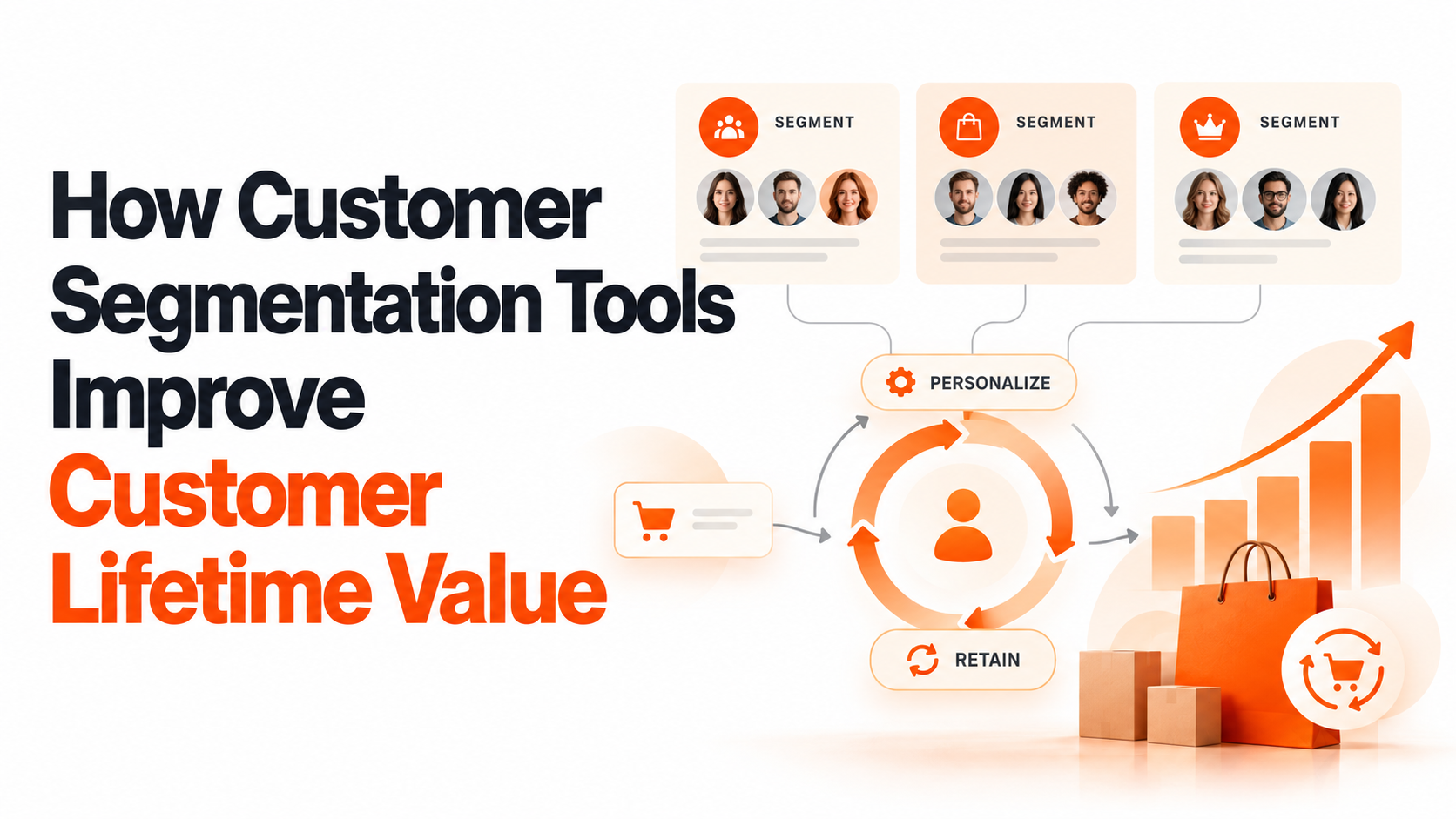
AI-driven customer segmentation replaces hand-built rules such as “bought twice in 90 days” with groups the model finds from behavior, product affinity, and predicted value. These segments update as shoppers act, so a customer moves from “new” to “likely repeat buyer” without anyone editing a list. The payoff is sharper email, SMS, and paid audiences, and fewer discounts given to people who would have bought anyway.
See how this works in practice in LayerFive’s overview of AI customer segmentation marketing tools.
Marketing attribution analytics
Marketing attribution analytics answers one question: which ads, channels, and touchpoints deserve credit for each order. Last-click models credit the final visit and ignore everything before it. Multi-touch models spread credit across the journey, and they depend on identity resolution to link visits from different devices. For ecommerce, attribution is the base layer of AI analytics for marketing ROI, because every budget decision references it.
LayerFive’s multi-touch attribution guide for Shopify explains the models and the tracking behind them.
Customer behavior analytics
Customer behavior analytics follows what visitors do across the funnel: which pages they view, where they drop out, how many days pass between first visit and purchase, and what repeat buyers do differently. AI adds pattern detection at a scale a person cannot match. It can spot that visitors from one campaign abandon at checkout twice as often as another, then pass that finding to retention and ad workflows.
Five misconceptions about AI analytics platforms
Most buying mistakes in this category trace back to five wrong assumptions: that AI replaces analysts, that adopting AI equals getting results, that AI can repair bad data, that ad platform ROAS is good enough, and that a bigger stack is a better stack. Each assumption sounds reasonable in a sales demo. Each one costs money when it meets real ecommerce data.
AI replaces analysts. It does not. Gartner’s 2026 CMO Spend Survey found labor’s share of total marketing budget rose from 21.9% in 2025 to 24.5% in 2026, which Gartner reads as recognition that AI value depends on people, skills, and execution. A good platform removes spreadsheet work so analysts can spend time on decisions.
Adopting AI equals getting results. Deloitte’s State of AI in Retail and CPG executive survey of 200 executives found that 75% call AI a top strategic priority, yet only 16.5% can quantify a return. Adoption is easy to buy. Measured return requires a baseline, a holdout test, and numbers finance will accept.
AI can repair bad data. Salesforce’s 98% data-barrier finding says otherwise. A model trained on duplicate profiles and mismatched order totals will learn the duplicates. Fix identity and reconcile revenue first.
Ad platform ROAS is good enough. Meta and Google each report conversions credited to themselves, and added together those totals can exceed the orders your store actually received. A first-party attribution layer reconciles the claims against real orders.
A bigger stack is a better stack. Gartner’s survey found that 70% of CMOs say their internal marketing processes are not mature enough to implement and scale AI. Adding tools to immature processes adds cost faster than value, so consolidation is often the better first move.
How LayerFive approaches AI analytics for ecommerce
LayerFive is a unified marketing intelligence platform for Shopify brands, agencies, and SaaS companies. It replaces a patchwork of connectors, BI tools, identity vendors, and attribution software with four connected products: Axis for data unification and reporting, Signal for attribution and identity resolution, Edge for predictive audiences and activation, and Juno for agentic AI. LayerFive holds ISO 27001 certification and SOC 2 Type II compliance.
Axis: unified data and reporting
Axis is LayerFive’s data unification and reporting product. It connects Shopify, Meta, Google Ads, TikTok, Klaviyo, and other sources through plug-and-play connectors and puts them into executive dashboards without custom engineering. LayerFive reports that ecommerce teams save about half of their reporting time. Axis comes first because every prediction and attribution model that follows depends on one trusted set of numbers.
Signal: attribution and identity resolution
Signal is the attribution and identity layer. A first-party pixel and identity resolution connect anonymous visits to known customers across devices, so attribution reflects the full journey instead of the last click. LayerFive reports 92% identity match accuracy and identification of two to five times more visitors than the five to fifteen percent industry standard. In January 2026, it also released a Meta Signals Gateway CAPI integration.
Edge: predictive audiences and activation
Edge turns unified data into predictive audiences. It scores shoppers for purchase likelihood, churn risk, product affinity, and lifetime value, then syncs those segments to Meta, Google, and Klaviyo. Cart recovery flows and high-LTV audiences are the usual first uses. LayerFive reports a 20% ROAS uplift when first-party CAPI is paired with modeled attribution. That figure is company-reported, so validate it against your own data.
Juno: agentic AI on unified data
Juno is LayerFive’s agentic AI layer. It watches unified data for anomalies such as a ROAS drop or creative fatigue, sends alerts, and supports automated optimization. Because Juno reads the same identity-resolved data as the other products, its recommendations rest on one version of the numbers. Agencies and Shopify brands use it as an early-warning system across accounts, a point covered on the Shopify solution page.
How to choose an AI analytics platform for ecommerce
Choose an AI analytics platform by testing six things in order: the data foundation, attribution transparency, prediction quality, activation, security, and total cost. Ask each vendor to show the same store’s numbers in a live trial rather than a demo environment. Everything else depends on the first. A platform that cannot reconcile revenue to your own order totals should not be trusted to forecast anything.
- Data foundation. Confirm native connectors for your store, ad platforms, and email tool, plus first-party tracking and server-side event delivery. Ask how duplicate profiles are merged.
- Attribution transparency. You should see which model produced each number and be able to compare it with platform-reported results.
- Prediction quality. Ask for holdout testing on predicted audiences so lift is measured, not assumed.
- Activation. Predictions have to flow back into Meta, Google, and your email platform without manual exports.
- Security and governance. Look for independent certifications such as ISO 27001 and SOC 2 Type II, and ask about data retention terms.
- Total cost. Count connectors, BI, identity, and attribution tools you would retire. LayerFive’s site lists pricing from $49 per month and reports $100K to $1M or more in annual savings from Axis consolidation. Check the pricing page for current plans.
LayerFive compared with other approaches
No single tool fits every brand, so compare by job. GA4 is a free, session-based analytics tool. Supermetrics moves marketing data into spreadsheets and warehouses. Triple Whale and Northbeam focus on ecommerce attribution and reporting, and Hyros centers on ad tracking. LayerFive combines unified reporting, identity-resolved attribution, predictive audiences, and agentic AI, so brands that want one connected stack can consolidate several tools.
GA4 remains useful for site behavior, and many brands keep it. The gap appears when a team needs order-level attribution tied to customer identity, because session-based reporting was not designed for that. Supermetrics solves the connector problem well, but it leaves modeling, identity, and activation to other tools you still have to buy and maintain.
Triple Whale and Northbeam are established choices for Shopify brands that mainly need attribution dashboards. Hyros is often chosen for tracking paid traffic. LayerFive’s own site claims a lower cost than legacy platforms such as Triple Whale and Northbeam and adds identity resolution, predictive audiences, and agentic AI in the same platform. Run any shortlist through the same live-data test described above, and read LayerFive’s roundup of the best attribution platforms for Shopify brands for a wider comparison.
A 90-day rollout plan
A realistic rollout takes 90 days in three phases: connect and verify, attribute and segment, then activate and automate. Each phase ends with a check against real order data. Teams that skip the first phase usually spend the next two arguing about whose numbers are right. Teams that finish it spend the rest of the quarter acting on numbers everyone trusts.
Days 1 to 30: connect and verify
Connect the store, ad accounts, email platform, and site tracking in the first month. Then compare unified revenue against your store’s own order totals and fix gaps before trusting any model. Install first-party tracking and server-side event delivery so platform signals improve at the same time. The goal for month one is one reconciled set of numbers that finance and marketing both accept.
Days 31 to 60: attribute and segment
In month two, turn on multi-touch attribution and compare it with each ad platform’s own reporting. Expect disagreement, and investigate the largest gaps by channel. Build your first predictive segments at the same time: likely repeat buyers, churn risks, and high-value lookalikes. Run each audience against a holdout group so you can measure incremental revenue instead of assuming the lift.
Days 61 to 90: activate and automate
In month three, sync predicted audiences to ad and email platforms, shift budget toward channels the reconciled data supports, and set alerts for ROAS drops and creative fatigue. Review results against the month-one baseline using revenue, new customer share, and repeat purchase rate. Keep a record of each budget decision and its outcome, because that record is what makes recommendations improve over time.
Proof point: Billy Footwear
Billy Footwear grew revenue 36% with only 7% additional ad spend after adopting LayerFive, according to LayerFive’s published case study. LayerFive’s site also lists a 23% rise in repeat purchases within 90 days of use. Those results come from one brand’s data, so treat them as a reference point for what unified attribution can surface, and test your own numbers before setting targets.
Read the full Billy Footwear case study for the setup and results, or browse other LayerFive case studies.
Frequently asked questions
Q: What are AI analytics platforms for ecommerce?
A: AI analytics platforms for ecommerce are tools that unify store, ad, email, and website data and apply machine learning to it. They report results, predict customer lifetime value, score audiences, assign revenue credit across channels, and alert teams to problems. The main difference from basic reporting is the prediction and action layer, which tells you what to do next instead of only what happened.
Q: What is the best AI analytics platform for ecommerce brands in 2026?
A: The best AI analytics platform is the one that unifies your store, ad, and email data, resolves customer identity, and shows how it reaches its numbers. For Shopify brands that want those capabilities in one stack, LayerFive is a strong option, combining Axis, Signal, Edge, and Juno. Verify any platform by comparing its revenue totals with your own orders during a live trial.
Q: How do AI analytics platforms improve ecommerce performance?
A: They improve performance in three ways. They reconcile data so budget decisions rest on one set of numbers. They predict which customers and campaigns will produce the most value, so spend shifts toward them. They also automate monitoring, flagging ROAS drops and creative fatigue early. Results vary by brand, so measure gains with holdout tests and a pre-launch baseline of revenue and ROAS.
Q: How is AI ecommerce analytics different from GA4?
A: GA4 is a free, session-based analytics tool that reports site behavior and conversions. AI ecommerce analytics adds identity resolution across devices, order-level multi-touch attribution, predictive customer value, and audience activation. Many brands keep GA4 for traffic reporting and add an AI analytics platform when they need to link ad spend to customers and revenue. LayerFive publishes a direct comparison of the two.
Q: Do AI-powered ecommerce analytics tools work for Shopify brands?
A: Yes. Many AI-powered ecommerce analytics tools connect to Shopify through native integrations and read orders, products, and customer records. LayerFive is built for this case: Axis connects Shopify with Meta, Google Ads, TikTok, and Klaviyo, Signal resolves identity for attribution, and Edge syncs predicted audiences back to ad and email platforms. Setup usually starts with connecting the store and verifying revenue totals.
Q: How do I choose an AI analytics platform for ecommerce?
A: Test six things in order: data foundation, attribution transparency, prediction quality, activation, security, and total cost. Run a live trial on your own store and check that unified revenue matches your order totals. Ask for holdout testing on predicted audiences, and confirm certifications such as ISO 27001 and SOC 2 Type II. Price the tools the platform would let you retire.
Q: How does AI improve marketing attribution and ROI measurement?
A: AI improves attribution by using identity resolution to link visits across devices and by modeling how each touchpoint contributes to an order. This replaces last-click credit with a view of the whole journey. For ROI, it compares channel spend with reconciled revenue and customer value. IAB’s State of Data 2026 found that 75% of marketers say current measurement falls short, so a second opinion helps.
Q: What data does an ecommerce data analytics platform need?
A: An ecommerce data analytics platform needs order and customer records from the store, spend and click data from ad platforms, email and SMS engagement data, and first-party site events such as page views and cart actions. Identity resolution then links these records to one customer profile. Clean, connected inputs matter more than volume, because duplicate or mismatched records weaken every prediction.
Q: How much do ecommerce analytics software platforms cost?
A: Costs range widely by brand size and stack. LayerFive lists pricing from $49 per month and reports that consolidating a fragmented stack through Axis saves $100K to $1M or more per year. When comparing vendors, add up the separate connector, BI, identity, and attribution tools you would replace, plus the staff hours spent reconciling reports every week, not only the subscription price.
Q: Is customer data safe in an AI analytics platform?
A: It can be, if the vendor proves it. LayerFive is ISO 27001 certified and SOC 2 Type II compliant, uses first-party data collection with optional third-party enrichment, and keeps data for 18 months as standard, with longer retention on Enterprise plans. Ask any vendor for its certifications, retention terms, and consent handling, and review its trust page before you connect data.
Conclusion
AI analytics platforms for ecommerce pay off when the data underneath them is unified, identity-resolved, and checked against real orders. The 2026 evidence is consistent: ecommerce is growing, AI-driven traffic is rising, budgets are flat, and most marketers distrust their measurement. Brands that fix the data layer first can then use prediction, segmentation, and agentic AI with confidence and fewer wasted dollars.
If you want to see how LayerFive approaches AI analytics for ecommerce, start with the LayerFive Shopify solution page.
Sources and data
All statistics in this article come from 2026 publications.
- US Census Bureau, quarterly retail e-commerce sales, Q2 2026 (17.1% share of retail): FRED series ECOMPCTSA
- Practical Ecommerce, coverage of the Census Bureau Q2 2026 release ($340.2 billion, up 12.2%): Double-digit ecommerce growth returns
- eMarketer, US Ecommerce 2026 forecast (7.9% growth; AI-driven share 3.2% to 15.8%): US Ecommerce 2026
- Gartner, 2026 CMO Spend Survey (7.8% of revenue, 15.3% to AI, 56% lack budget, 70% and 30% readiness): Gartner press release, May 11, 2026
- Gartner, 2026 CMO Spend Survey (62.6% awareness and conversion share; labor share 24.5%): Gartner press release, June 8, 2026
- IAB and BWG Global, State of Data 2026 (75% say measurement falls short; $26.3 billion): IAB State of Data 2026 and MarTech coverage
- Salesforce, State of Marketing 2026 (98% data barrier; 84% generic campaigns; nearly 4,500 marketers): Salesforce State of Marketing 2026
- Salesforce, State of Marketing 2026 regional release (42% more likely to respond when data is unified): Salesforce press release, June 16, 2026
- diginomica, analysis of Salesforce State of Marketing (seven data sources; 46% lack preference data): diginomica, February 25, 2026
- Forrester, Predictions 2026 B2C Marketing (7% confidence decline; 64% expect more volatility): Forrester blog and Marketing Dive coverage
- Shopify, Q1 2026 earnings call (AI traffic 8x, AI orders nearly 13x, first-time buyers at nearly twice the rate): PYMNTS and Digital Commerce 360
- Deloitte, State of AI in Retail and CPG executive survey (75% top priority; 16.5% can quantify return): Deloitte Insights
- LayerFive company-reported figures (92% identity match accuracy, 20% ROAS uplift, reporting time saved, certifications, January 31, 2026 Meta Signals Gateway CAPI release): layerfive.com